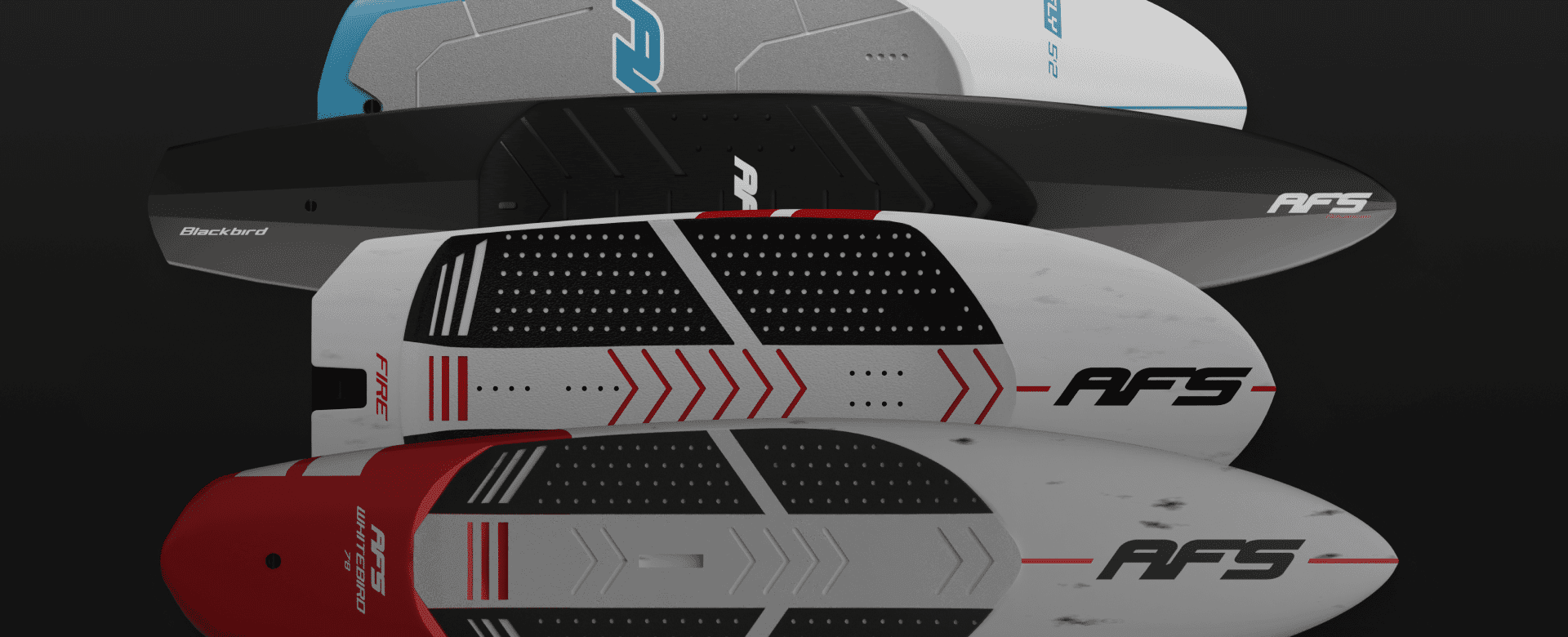
The manufacturing process is essentially the same: a core of low-density foam (EPS) is created, which is then encased in a rigid shell.
This is often a sandwich composite, combining fiberglass or carbon with a high-density foam several millimeters thick.
The materials
What modifies the board’s properties are the materials used and the order in which they are positioned. Here are the different materials that can be found in a board:
EPS foam
A foam of variable density forms the core of the board, also known as the foam block. It ensures the board’s rigidity and buoyancy, while remaining lightweight. The density of the foam block has a major impact on the board’s final weight.

Fibres de verre / Glass Fiber
Fiberglass is a solid material that makes for robust board construction. It has a higher density than carbon and is less rigid, but is nonetheless far more affordable, making it an asset in rigid and affordable board construction.

Carbon
The stiffness/density ratio of this material makes it one of the most widely used in high-performance construction. It can make up the entire board envelope, or simply reinforce certain strategic areas. Carbon is available in varying degrees of stiffness, enabling you to push the limits of gliding while guaranteeing rigidity and responsiveness.

PVC
This foam is generally four times denser than EPS core. It comes in sheets of various thicknesses, depending on the application (deck, US rail, etc.). The combination of PVC foam and glass or carbon fiber fabric forms a sandwich material. It conforms to the shape of the core to reinforce and stiffen it, while guaranteeing maximum lightness.

Epoxy resin
It binds all the elements together and ensures that the board is watertight.

The basics of construction
Let’s take a closer look at the construction of the boards:
The core forms the basis of the board. There is a direct link between the choice of density and the construction that will be built around it, depending on the weight targeted for the final product.
The denser the foam used, the heavier it will be, but the more resistant it will be to compression and impact. With a denser loaf (therefore heavier but stronger), we can afford to make a lighter envelope with stiffer materials such as carbon.
It’s a question of balance and compromise, depending on what you want from the final product.
This is where the notion of sandwich construction comes in.
For PVC sandwich constructions, the principle is to enclose the PVC sheets between several layers of glass or carbon in order to benefit from the mechanical properties of the fibers while limiting the weight, thus ensuring unfailing strength.
Carbon or glass reinforcements are then carefully positioned according to the intended use, to optimize the board’s strength and rigidity. This is the advantage of composite materials, which can be strategically placed to optimize strength and weight.
At AFS and AFS Advanced, we distinguish between several types of construction – the process remains broadly the same, but the materials used vary according to the type of construction:
Sandwich-Bauweise
Firstly, the sandwich structure offers high impact resistance and is a durable construction.
PVC Sandwich Glass
For Sandwich Glass PVC constructions, the principle is to enclose the PVC sheets between several layers of glass fibers to take advantage of the mechanical properties of the fibers while limiting weight, thus ensuring unfailing strength.
The PVC Sandwich Glass structure offers high resistance to impact and wear. Suitable for all skill levels, from beginner to advanced, these are versatile and durable boards offering excellent value for money.

PVC Sandwich Glass Carbon
It’s the same construction process as PVC Sandwich Glass, with the addition of carbon reinforcement in certain areas, depending on the board’s intended use. Core density can also be changed to ensure lighter boards.
It’s the ideal compromise for a lightweight, durable board—a low-density core and sandwich glass construction reinforced with carbon strips. At AFS, the Whitebird best represents this type of construction.
PVC Sandwich Glass Carbon construction is particularly suited to riders looking for a high-performance, lightweight and durable board at an affordable price.
PVC Sandwich Carbon
In this construction, the sandwich manufacturing process with fibers and PVC is still used, but the fabric of the envelope changes. Instead of being made of glass fibers, it is made entirely of carbon.
On each side of the EPS core, a multidirectional carbon fiber fabric is applied. This material, known for its stiffness-to-density ratio, reinforces the board while optimizing its weight. This technique optimizes the distribution of forces within the board, improving its stiffness in all directions and its overall responsiveness.

Triaxial Carbon Construction
AFS Advanced Construction
Triaxial Carbon is a weave of carbon fibers along three different axes, offering outstanding strength and rigidity at minimum weight. For this type of construction, we use a denser-than-usual EPS core.
To ensure a lightweight, strong and rigid board, a carbon/PVC sandwich reinforcement is located on the deck’s footprint and around the US rail housings. This is complemented by carbon stiffeners along the length of the board, for added responsiveness.
These technical elements, put together, form a compromise that maximizes the lightness, strength and rigidity of our boards.
“When performance rhymes with lightness”

The manufacture of a Triaxial Carbon board is a complex and meticulous process that requires craftsmanship and cutting-edge technology. That is why this manufacturing technology is implemented in the same premises where we manufacture our foils in Brittany.