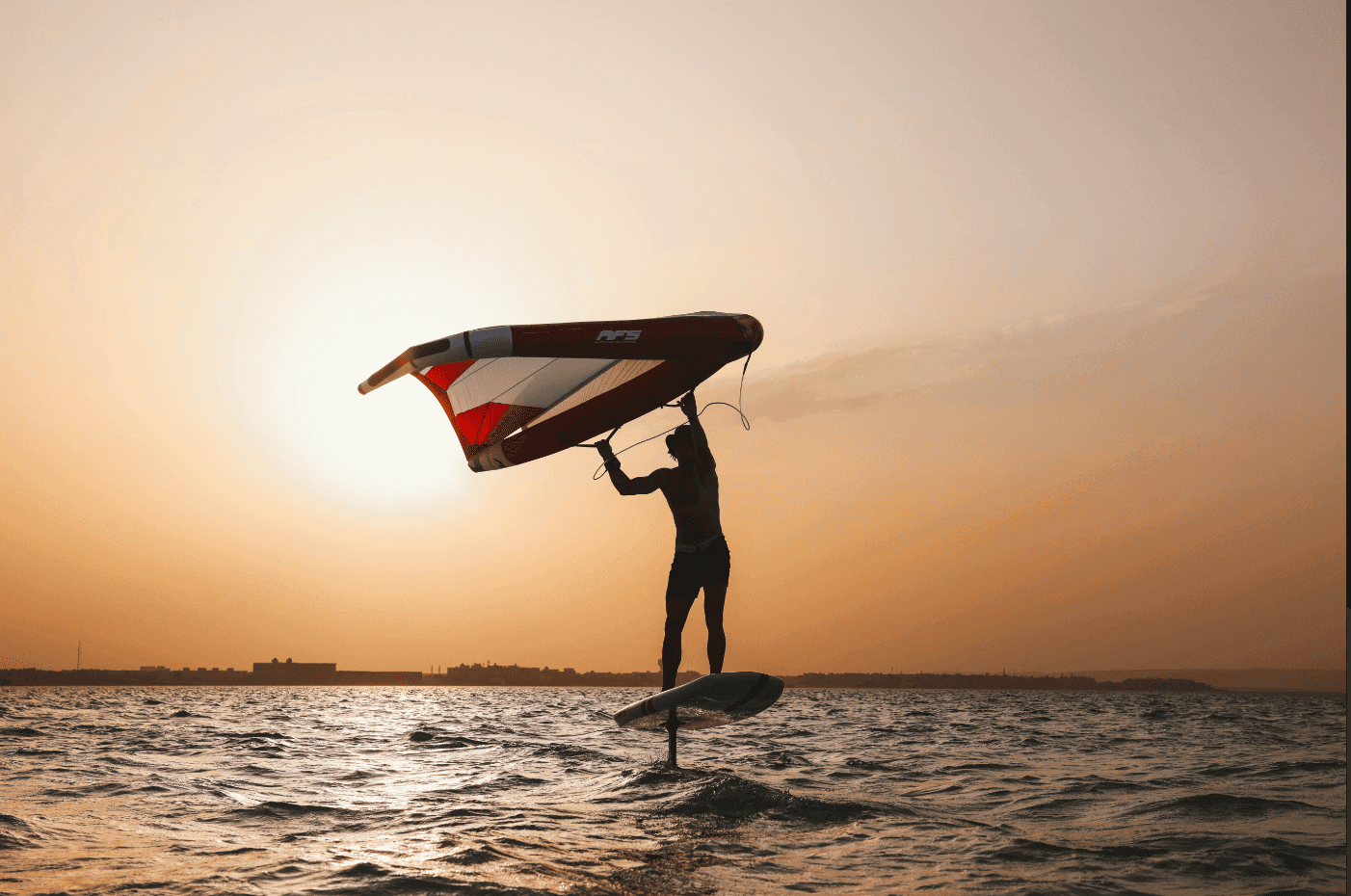
Ready to glide over the water? Wingfoiling, a new water sport, is something unique and we all get hooked on it. Flying for the first time gives you an incredible feeling of freedom. But to fully enjoy this sport, which is close to pure bliss, it’s essential to master how to control your sail. As the driving force behind all your wingfoil equipment, it requires a specific technique to get the most out of the wind. From hand position to power adjustment, these tips will guide you step by step as you learn how to control your wing.

What makes up a wingfoil?
The wing is an essential component of wingfoiling. It propels you across the water using the force of the wind. It usually consists of two inflatable tubes, which form the main structure of the wing: the leading edge is often reinforced to withstand impacts, while the smaller central batten is slightly more flexible. Finally, there is the canopy, which represents the sail and determines the surface area of the wing in square meters. Sometimes there are two small rigid battens on the trailing edge to reinforce the profile and optimize performance.
But how do you hold your wingfoil?
The middle bladder, which divides the sail into two parts, is equipped with two handles (sometimes more, depending on the brand) or a wishbone (boom). With some brands, it is now possible to choose between these two options (for only a few wing models).
Handles can be :
- soft: ideal for optimum safety without hurting your hands. And a wing that’s easy to carry anywhere, without taking up too much space.
- semi-rigid: for improved feel and optimum connection with the wing, offering precise control with minimum effort.
- rigid: to maximize power and facilitate pumping. Ideal for reaching higher speeds and being perfectly in tune with the wing.
The boom:
with the boom, the feeling is even more immediate, offering incomparable precision, especially when manoeuvring. It also makes it easy to correct certain errors.
The choice of kite size is obviously essential, and depends on your size, weight, skill level, wind conditions and planned wingfoil program (freeride, wave, freestyle, race). If the wing is too small, you’ll be under-winged, while one that’s too big will be harder to control.
Since 2019, when wingfoiling first began, the materials used to manufacture wings have evolved considerably. Today, brands such as AFS offer lighter and more resistant fabrics, providing better performance and increased durability. The sails are now designed to be both maneuverable and intuitive, allowing beginners and experts alike to get the most out of every wingfoil session.
And to optimize your sessions, don’t neglect the rest of your wingfoil equipment, which must be suited to your level. In fact, the board and foil are just as important as the wing.
What are the best techniques for manoeuvring your wing?
Learning to fly a wing foil takes a little patience and practice. Here are a few tips to help you along the way:
1. The basics
Start by familiarizing yourself with your equipment on dry land. Inflate your wing, handle the handles or the wishbone with the wind at your back (as if you were riding crosswind). To identify the direction of the wind, observe whether a flag is flying around you. If not, use your face: when the wind passes on either side of your ears, it is blowing towards you. Feel free to pass the wing over your head to identify when it is neutral (without wind resistance). Once on the water, stand on your board and let yourself be carried by the wind, always at your back. Find your balance and learn to feel the different forces exerted on the sail and around you.
2. Lift-off
To take off and successfully perform a waterstart, position yourself sideways to the wind with one hand on the front of each handle. Keep the wing pointing forward, extend your arms, and pull slightly on the handles. Next, lean your body forward from your knees to your head and transfer your weight to your front foot. Your legs should be apart, with the front leg slightly in front of the center of the board and the back leg close to the rear footstrap inserts. The kite will quickly inflate and propel you forward. Make sure your body is neither too tense nor too bent for better balance.
3. Navigation
Beginners tend to pull too hard on the handles or boom, which can cause falls. It is important to find a balance between the power of the wing and your own strength. You should also avoid being caught off guard by gusts of wind and make sure you maintain a stable position on the board.
4. Mistakes to avoid
Once in the air, focus on your posture and the direction of the wind. To turn, point the wing in the desired direction. Your shoulders and hips will guide you in steering your course on the water. The wing follows the movement of your shoulders, not the other way around. As for your feet, especially the one above the foil, simply press down lightly on the board to adjust your direction and improve stability.
5. Additional tips
To progress more quickly, don’t hesitate to take lessons at a sailing school or watch video tutorials on YouTube. A little help and some extra tips will probably help you correct your mistakes.
How do you manage the combination of speed and wind with your wingfoil?
1. Wing adjustment
- Power: by pulling more or less on the handles, you adjust the power of the wing. The more you pull, the faster you will go once in flight and the more stable you will be on the board.
- Orientation: The angle of the wing relative to the wind influences your speed and direction. A more open wing accelerates, while a more closed wing slows you down. It all depends on your speed (downwind, crosswind, upwind).
2. Body position
- Weight forward: to go faster, shift your weight to the front of the board. This increases pressure on the foil and reduces drag.
- Arms outstretched: keeping your arms almost fully extended allows you to better feel changes in the wind in the sail and adjust accordingly.
3. Choice of equipment
- Wing size: a smaller wing is generally more responsive and allows you to go faster, but it requires more technique.
- Foil size: a smaller foil offers better acceleration and less drag, while a larger foil offers more stability at low speeds.
4. Wind conditions
- Light wind: In light wind conditions, it is important to pull gently and gradually on the wing to maintain speed. The adjustments are more subtle. Almost two fingers are enough to trim the sail.
- Strong wind: reduce the power of the wing by slightly easing off the wing, i.e. by loosening the handles a little.
5. Pumping technique
This involves making small circular movements from front to back and up and down with the sail to maintain speed and gain height. This is to avoid touching the water.

How do I get upwind in a wing foil?
Body position
Position your feet in front of the strap inserts. The front one should be even above the inserts, but slightly further back than for crosswind sailing. Lean your body back, almost sitting up, and press down on your heels. This position allows you to counteract the force of the wind and maintain a constant angle to it. Your center of gravity drops.
Wing adjustment
Tuck in the wing, but don’t pull too hard either, to avoid deviating from your course. Your shoulders look into the wind, as does your face.
Board orientation
Point the nose of your board towards the wind. It should tilt backwards, your body weight should shift backwards, and your buttocks should be close to the surface of the water. The idea is to be more or less in a sitting position, a bit like you were sitting in a large armchair without actually sitting down.
How do I wing-drop?
A broad reach is a faster point of sail than a close reach. It involves sailing away from the wind at an angle of approximately 135°. However, this point of sail can more easily cause the boat to capsize.
Body position
Place your feet further forward on the board to make it easier to slide. And lean your body slightly forward as well to lighten the rear of the board. Your center of gravity will rise.
Wing adjustment
The action consists of gently bumping the wing to deliberately lose power and avoid falling. This helps maintain a constant speed.
Board orientation
Point your board away from the wind axis and make wide, gradual S-shaped turns (without turning). For beginners to wingfoiling, as with kitesurfing or windsurfing, this is a very progressive exercise for learning how to steer on the sea. However, always remember to look towards the shore and avoid straying too far from the edge. Once you have mastered these two basic maneuvers, you can start training for the next step: performing transitions such as jibes and tacks. Upwind sailing (or sailing close to the wind) and downwind sailing will help you change direction more smoothly.

In summary, wingfoiling is an exciting water sport that offers unique sensations. With patience and perseverance, you will progress quickly and enjoy the intense pleasure of gliding and flying just a few inches above the water. However, don’t forget that practicing wingfoiling regularly is the key to progressing quickly.