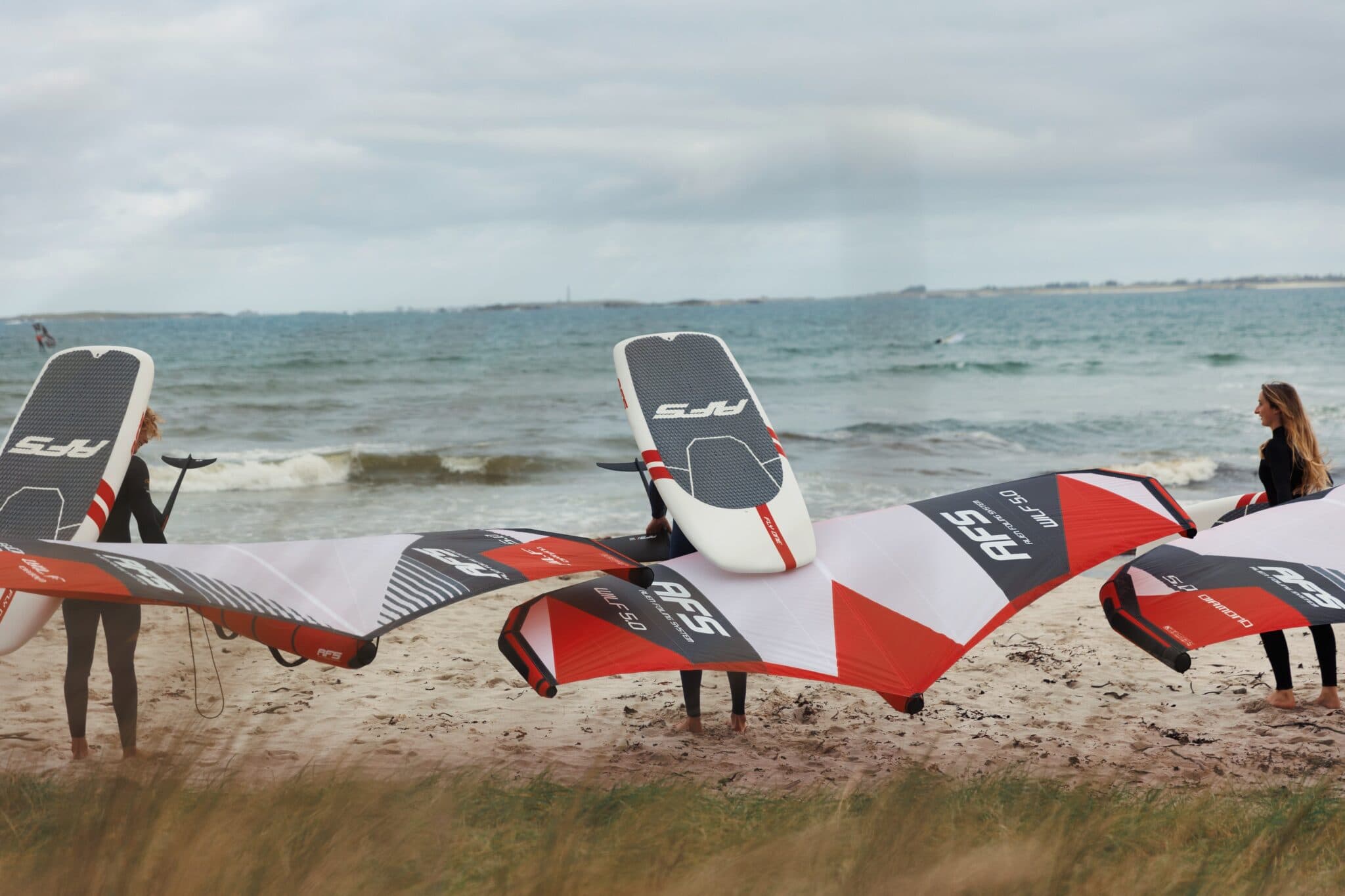
Wingfoiling is a board sport practiced on water while standing, just like windsurfing and kitesurfing. Except that here, you start out sitting on the board—at least when you first begin this board sport—before standing up.
But maybe you’re struggling to get up and take off? At AFS Foiling, we look out for our riders, which is why we’re giving you some technical tips for beginners in this article, which are essential for wing foiling.

What wing foil equipment should I use to stand up without difficulty?
Are you new to wing surfing and need some extra advice on equipment? Choosing the right wing surfing gear is important to avoid struggling once you’re in the water, even when kneeling on the float, especially as a beginner. A sail, board, and foil that are well suited to the rider and the weather conditions will allow them to learn and progress more quickly.
The board

To get started in wingfoiling, a large board is highly recommended. Allow for 30 to 40 liters more than your weight to be comfortable, whether sitting or standing on the board and therefore on the water. A wide board with plenty of volume offers greater stability, making it easier to take off and land, especially in light wind conditions. A stand-up paddleboard (SUP) can also do the job for your first outing on the water, before you learn to fly.
The hydrofoil

The foil, whose lower section remains submerged throughout the session, needs a large surface area. The front wing (between 1,500 and 1,900 cm² depending on your weight) and the rear stabilizer (around 240 to 300 cm²) thus contribute to better lift at low speed, making take-off earlier and easier without too much effort. Front wings with a large surface area are therefore preferable when you’re just starting out, to ensure stability and a smooth take-off.
The foil’s mast is not to be overlooked when starting out in wingfoil either. Very short (between 60 and 70 cm), it facilitates control of the foil once in the air, thus reducing the risk of falling. But too short also means more touchdowns on the water surface and more stalls once airborne. An ideal compromise for beginners is a foil mast between 75 and 80 cm.
As far as the fuselage (the part between the front wing and the stabilizer) is concerned, it’s best to make it long enough when you start out. A length of 70 cm gives the rider greater stability and smoother control in the air. Transitions are smoother, too, to avoid pitching too much during maneuvers. Nonetheless, a short fuselage offers more dynamic navigation, but that’s something to consider once you’ve gained more experience.
The wing

For the wing (also called a sail or kite), it is advisable to choose a size that is appropriate for the wind strength and your weight. In light winds, it is best to opt for a larger wing to get better traction and make takeoff easier. Conversely, in stronger winds, a smaller sail is more maneuverable. When learning to wing, it is generally recommended to be overpowered so that you have a little more power in the sail rather than too little. The main objective is to stand up and then fly. If you are underpowered, this will be more difficult. To start with, the ideal size is 4m² for a person weighing less than 75kg… And 5m² for a single sail for heavier people.
The right wingfoil equipment makes learning much easier. As you might expect, your choice of gear depends on your skill level and the weather conditions on the day. Don’t overestimate your abilities by buying a board or foil that is too small… or perhaps a single wing that is much too large for your body type! To help you choose the right wing equipment, it’s best to talk to brands or shops, watch tutorials and videos, or ask your instructor if you’ve taken wingfoil lessons… There’s no shortage of resources available today.
What tips do you have for standing up on your wing foil board?
When you’re just starting out, standing up on a wing foil board isn’t always easy. Wind that’s a little too strong or a little too weak + choppy water don’t necessarily help matters! However, with a few tips and some practice, this phase becomes more accessible for beginners.
1 – Position the sail correctly
While you’re still sitting on the board, your wing should be well oriented, so as to help you get the most out of the wind. First, position it downwind: your body is between the wind and your wing, ready to generate speed and traction. Once you start to feel a slight acceleration, you can move on to the next step. If you’re not sure where the wind is coming from, turn your face a little at a time until the wind is facing you, and passing by each of your ears.
2 – Position your knees on the board
Before attempting to stand up, it’s crucial to place your knees on the board, slightly towards the nose of the board, at an angle. This is the first step towards stability. Legs should be slightly apart and positioned towards the center of the board for better balance. Keep your kite slightly above your face, not touching the water.
3 – Sailing for speed
The wing must reach the speed necessary to lift the hydrofoil. Gently pull your wing toward you (pull = pull the handles or boom toward you), keeping your arms more or less straight and slightly bent. This is to maximize traction. It is necessary to achieve this acceleration while remaining stable on the board. Wait for it to pick up a little speed with the help of the wind blowing through the wing. Once the board is launched and stable, you can move from a sitting to a standing position. Start by lifting your front foot, as this will be easier. Keep your other knee in contact with the board. At this point, the wing should be high enough not to touch the water, but low enough to maintain good traction.
4 – Distribute your weight for balance
When you place your second foot on the board (back foot), make sure to distribute your weight evenly with your first foot. Be careful not to put too much pressure on the back. Keep your legs bent so that your center of gravity doesn’t suddenly become too high, and maintain your balance. This technique helps you maintain enough stability to avoid falling. And if there are markings on your board, use them! These could be footstrap inserts or the pad, or even a different color on the deck. If they are inserts, each foot should be just in front of each imaginary footstrap. Some beginners like to attach the front straps without even knowing how to fly first, and stick their front foot in them. This allows them to catch themselves in case of a potential fall.
5 – Feel the wind and the glide
The sail must continue to be well oriented downwind to obtain sufficient traction. Once upright, the sail helps you keep your balance. Here, feeling the wind is essential to keep you stable. Your board may face into the wind, or it may go into the wind. But this is not the right time to stand up. Your board should be at a 90-degree angle to the wind direction (crosswind or sidewind), or even at a slightly more open angle (this is called headwind). You stabilize your board by using the handles or boom to control the power of your sail and steer it. Either by gently tucking in the sail, or by releasing it slightly.
Tips for taking off in wing foil?
The wingfoil take-off, also known as the take-off or waterstart, is the stage during which the float rises out of the water… well, here we are!!!
Once you’re well equipped with wing gear and have found a spot that suits your level, with moderate weather conditions, it’s time to take to the water to progress in wingfoil.
The ideal wind range (steady if possible) should be around 18-20 knots. This is really the best for getting enough power without having to lift your sail with your arms. Or resort to pumping. A light wind is not necessarily your best friend. And if the wind is blowing side-shore (perpendicular to the beach), it will help you get started and return to shore more easily and calmly. The calmer the water, the better you can concentrate on your balance and your waterstart.
Sit down and stand up on your board, and let’s go for a moment of great thrills and chills!
Foot placement and sail control are very important, especially when you’re just starting out. The rear foot is positioned roughly above the foil plate (the base that connects the foil to the board). As for the front foot, it’s necessarily in front, 40-50 cm from the second, i.e. towards the center of the float.
If you feel the nose of the board rising too fast towards the sky, you’re probably too far back and your sail is too open. You’re dropping so much that you end up going wide. In this case, put a little weight on the front and trim your sail more. On the other hand, if the board is dipping towards the surface of the water and you’re luffing too much (going into the wind, getting closer to the wind direction), then back off a little and pull less on your sail!
In general, however, the most difficult thing is to control the trim: in other words, to keep the board in flight. And this requires both support on the board and control of the glider. If you’ve already got your position wrong before takeoff, it’s going to be difficult to fly for more than a few seconds. But if you manage to control your glider and position your feet and body correctly, you should be fine!
Remember that every part of your body – from your feet to your head, arms, legs and pelvis, not forgetting your shoulders – is under constant strain during flight. You have to constantly regulate your whole body. It has a controlling and influencing effect on your wingfoil equipment.
The float should remain about 30 cm above the water surface. Keep sailing crosswind to better manage your trim (when learning to wing). And if you manage to tilt the windward rail of the board slightly towards the water surface (counter-heeling), you will be able to gain speed and have more time to correct any mistakes in case of imbalance or potential fall.
Finally, just before the waterstart, when you feel your board accelerate and the foil start to lift you, relax and let it happen. Don’t force it, just pull lightly on the sail without pushing too hard on your heels. Tell yourself that you’re the captain of your new flying machine… And all that’s left for you to do is pilot your wing, which is, in a way, your engine at the start.
From now on, you need to practice wing foiling over and over again… Once you’ve mastered flying, Aladdin will have to watch out, and you’ll be enjoying long surfs in the swell!
