Wingfoil is

How do you manage your wing foil equipment on land?
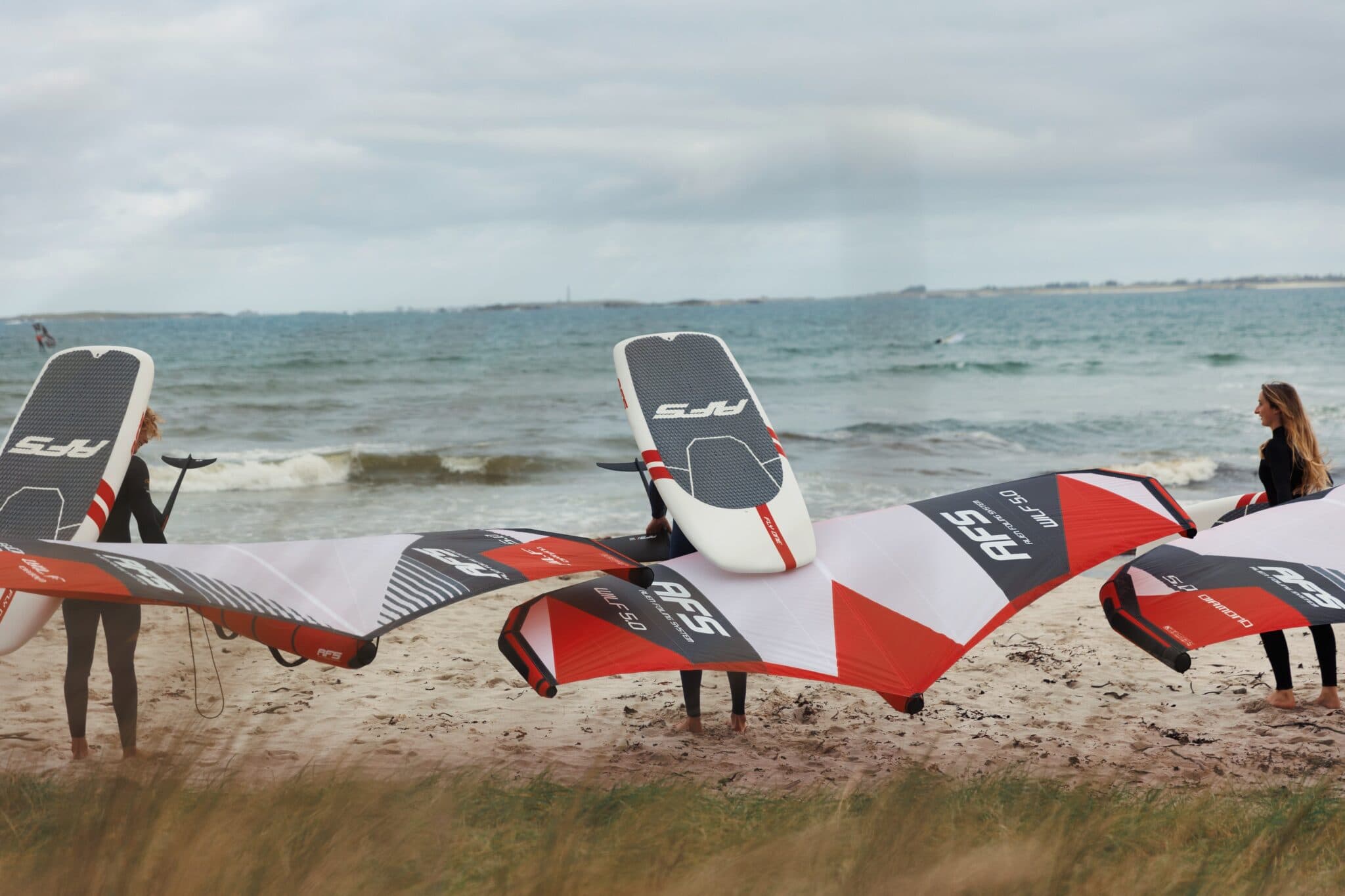
Before you go out and have fun flying on the water, it’s essential to manage your wingfoil equipment on land. On the one hand, to preserve your equipment, and on the other, to avoid injuring anyone. Make sure you have enough space in the parking lot and on the beach to prepare your foil and wing in complete safety, without disturbing others (walkers and other wingfoilers).
Preparing your wing foil equipment is an important step before sailing:
- Before screwing on the foil and inflating your sail, it is often a good idea to put on your wetsuit. This is to minimize the amount of time your equipment is left unattended. You can also put on your helmet and impact vest now to save time.
- Next comes the preparation of the board and the foil you’ll attach to it. If you have footstraps, attach them to the board first. Then orientate your board so that the tail is in line with the wind. This way, with your back to the wind, you’ll cut off its trajectory and be able to ride the foil smoothly, without it moving. Above all, the board mustn’t be perpendicular to the wind, otherwise, once the foil is up, it risks tipping over and falling over on its side. And that’s the end of the road, because it’s the front wing tip of the foil that hits the ground first. You can also set up your board with the nose facing into the wind, but it’s much less pleasant to set it up in the middle of the wind. To assemble the foil, start by putting the plate on your board, then the mast, the fuselage, and finally the carbon wings (front wing and stabilizer). Once the foil is attached to the board, bring it close to the water’s edge. Be careful, if the tide is rising, make sure you set them down a few meters higher. Then lay the board so that the deck faces into the wind. And in strong winds, it’s best to put the back of the board in the same direction as the wind. This avoids scratches if it skids on the ground. Or turning over in a strong gust. Don’t forget to check each screw, even if it means giving it a final tug with the screwdriver, but without tightening like crazy!
- All that remains is to inflate the wing, taking into account the wind strength. Choose the right wing surface area. It is better to be slightly overpowered than underpowered. Stand with your back to the wind, i.e., between the wind direction and the sail. Then check that you have set the correct pressure on your pump’s pressure gauge (as recommended by the sail manufacturer). If there is space near the shore, you can inflate next to your board. Otherwise, inflate near your car, on the asphalt (which should not be too hot in summer) or on the grass, but watch out for pieces of glass and thorns that may be lying on the ground. In fact, it is sometimes better to inflate on sand. Above all, never leave your wing inflated on its own without connecting it to a heavy object or your float. Otherwise, it could fly away and hit a passerby or a moving car.
- To finish preparing your wingfoil equipment, attach your sail’s leash to the board, just below the foil, while you stow your pump. The sail should be turned upside down, with the bottom facing the sky and the leading edge (the larger bladder) facing into the wind (as when inflating). When you’re ready to launch, first tighten the board leash around your waist (or ankle), then the wing leash around your wrist.
- Launching: When entering the water, your board is upside down, with the foil facing the sky. At this point, your sail should always be downwind of your board, so that it does not get torn by the foil. Furthermore, even with a more advanced level of wingfoiling, you can be caught off guard by waves before you even have time to climb onto your board. That’s why you should always position yourself between the breaking waves and your board. Hold your wing in the air with one hand and the board with the other.
Once you’re on the water, there are a few safety precautions to keep in mind…
How to practice wingfoil safely on the water?

Whether you’re a beginner or an experienced rider, there are a few rules you need to follow to avoid endangering yourself or others.
Choice of spot and wind conditions adapted to your level:
- Choose calm or slightly choppy waters when you start wing surfing. Finally, make sure there are few or no obstacles (rocks, boats, reefs) and that the water is deep enough… This will allow you to surf comfortably and progress more easily.
- Choose calm or slightly choppy waters when you start wing surfing. Finally, make sure there are few or no obstacles (rocks, boats, reefs) and that the water is deep enough… This will allow you to surf comfortably and progress more easily.
- Weather conditions may change during your session, so don’t hesitate to talk to other windsurfers on the beach and check the forecast before you go out.
Take precautions:
- Avoid dangerous areas, such as those too close to rocks.
- To avoid any problems, don’t turn or manoeuvre without looking around first. Just so you don’t crash into another rider.
- If you see another person standing still or splashing around, get out of the way! Whether it’s a boat or just a bather. Take a wide berth.
- On the other hand, when you’re new to wing foiling, you tend to drift because you’re not looking at the shore. Either because you’re excited about your first few turns, or because you’re hyper-focused on your board. But keep in mind that you can quickly drift away from your starting point. If you get into trouble, never let go of your board. It’s a bit like your life raft if one of the wing’s tubes bursts. In short, don’t swim back without your gear.
- For more experienced riders who are addicted to jumps, do not jump near other riders or too close to the edge of the beach to avoid injuring another rider. Keep your distance; there is no such thing as zero risk, especially in strong wind conditions.
In short, to practice in safety, let’s respect each other, pay attention to the weather conditions, and be aware of our surroundings. This is the key to a safe and enjoyable wingfoil session.

What are the rules of priority in wingfoil?
In wingfoiling, safety on the water is paramount, especially at spots with lots of people in the water (wingfoilers, kitesurfers, windsurfers, and dinghy sailors). That’s why we all need to know the basic rules of right of way, which are essential for avoiding collisions and ensuring a good session for everyone.
But what are these basic rules?
1 – Starboard tack priority
When two riders are sailing in opposite directions, the one on starboard tack (wind from the right, right hand in front) has priority. The one on port tack (wind coming from the left, left hand in front) must let the other rider pass. This rule is essential for safe wingfoil riding, whatever your level. It’s forbidden to cut the path of the rider on starboard tack.
2 – A sailor who catches up with another rider does not have the right of way.
Thus, the rider who is being overtaken has priority, and the rider who is catching up (overtaking) must move out of the way. Ultimately, the faster of the two must move out of the way of the slower rider.
3 – Whoever is downwind has priority
The rider furthest from the wind direction has priority if they are neck and neck on the same tack (= same windward side, i.e. the wind is coming from the same side for both riders).
| Location | Priority rule |
| Starboard vs Port tack | Starboard tack priority |
| Caught up vs. Catching up | Priority to those who are catching up |
| Leeward vs Windward | The one sailing downwind has right of way. |
Of course, even though there are rules of right of way, sometimes you have to use common sense: if you see that another rider is going to cut you off, don’t crash into them, just move out of the way. It’s frustrating, but it will prevent a collision.
The advantage of knowing the rules and being vigilant both on land and on water is that you can enjoy every wingfoil session to the fullest… and avoid causing accidents. Once again, don’t forget your helmet and impact vest for extra protection. Of course, there’s wingfoiling on the water, but there are also other board sports riders in action.
