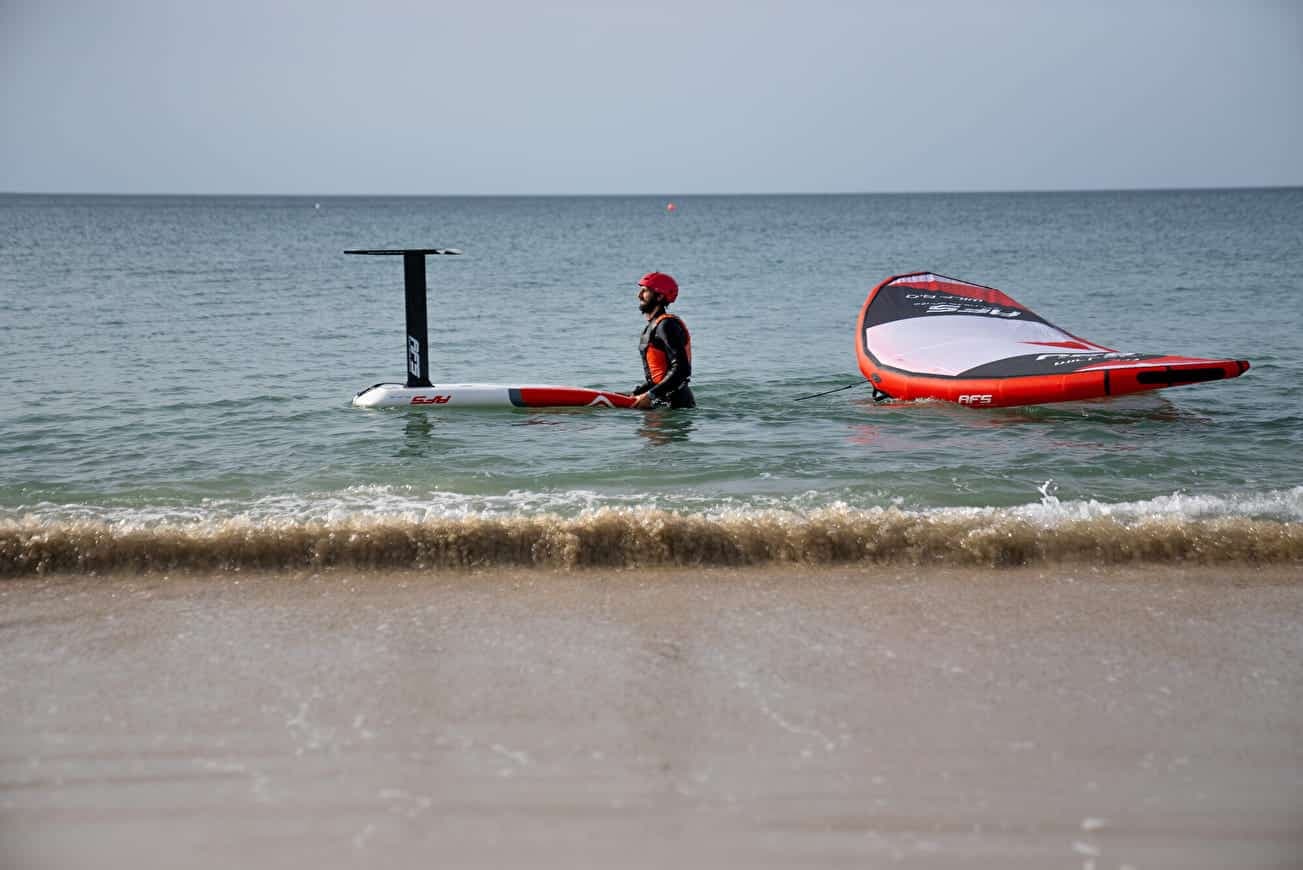
Are you looking for thrills? And if it’s outdoors and on the water, even better, right? So you want to try a board sport! Windsurfing, surfing, kitesurfing, stand-up paddleboarding… They’re all great! But have you ever tried wingfoiling? Imagine yourself gliding a few inches above the water. Wingfoiling, also known as wingsurfing, is a water sport that arrived on our beaches in spring 2019. It’s an ultra-addictive board sport, perfect for those looking for a unique and different experience.

Is wing foiling difficult?
Wingfoiling consists of an inflatable wing (the sail) and a foil mounted under a board. The foil, which resembles a large fin (or boat keel), allows you to gradually take off and fly above the water. Contrary to what one might think, it is a fairly accessible sport, provided you have a sufficiently large body of water (pond, lake, sea, ocean), favorable weather and wind conditions, the right equipment, know how to swim, and enjoy sports to some extent.
Let’s describe these factors together:

1. Weather conditions
The wind speed should be between 15 and 20 knots if you are a beginner at wing surfing. The wind should be steady and not too weak, which would make takeoff difficult. On the other hand, too strong a wind will be more technical to manage and will tire you out more quickly. In terms of wind direction, opt for a sideshore wind (perpendicular to the beach) or a side onshore wind (slightly oriented from the sea towards the land). The water and air temperature are also important. There is no specific season for wingfoiling, but it is less dangerous between April and November.
2. The body of water
To start with, choose a spot with no waves and little chop (little swell). If there is a little chop, it’s still doable. On the other hand, avoid spots where there are lots of rocks or other obstacles on (or under) the water. Also make sure that the water is at least 1.50 m deep.
3. Rider level
If you are already a windsurfer or kitesurfer, learning wing foiling will be quicker. However, if you are a complete beginner in water sports, we recommend taking a few wing foiling lessons to master the basics.
4. Choice of equipment
To get off to a good start, the size of the wing, the type of foil, and the volume of the board are factors that should not be overlooked. Equipment that is suited to your level is essential if you want to progress. A medium-sized wing is recommended (between 4 and 5 m² depending on your size). The foil should have a large front wing (surface area between 1600 and 1800 cm² approximately) to facilitate takeoff and provide good stability in flight. Finally, the board should have a volume of around 40 to 50 liters more than your weight. And don’t forget the neoprene wetsuit, helmet, and impact vest for your own safety.
In summary, the choice of equipment, weather conditions, and spot configuration are essential for successful wing foiling sessions. It is extremely important to sail in optimal conditions. And if you want to get started, improve, or be coached, it is now easy to find the right advice.
How to learn and improve at wingfoiling?
Wingfoiling has become a very popular water sport in many destinations around the world. Notably in France, Guadeloupe, Saint Martin, Europe, America, etc. Basically, almost anywhere there is water and wind! But how can you discover this exciting sport if you don’t have the equipment and want to finally get started?
Where to begin?
If you are a beginner, it is strongly recommended that you start with lessons at a wingfoil or sailing school. These centers offer lessons tailored to each level, supervised by qualified instructors who will guide you as you progress. There are many specialized schools offering different options: private, semi-private, or small group lessons. All types of courses and even wingfoil trips are available. The learning process can take several days, depending on your level and your willingness, of course!
What equipment should you choose?
Choosing the right equipment is essential when starting out. The advantage of attending a wing foil school is that your instructor will choose the right equipment for you during your course. And if you’re not taking lessons, wing brands such as AFS Foiling are also there to guide you and advise you on choosing the right equipment. Surf shops and tutorials available on web channels are also good resources to help you.
Where can you practice wing foiling?
To make progress easily, choose a spot with good weather conditions and calm water. A spot with sand and sufficient space will also be ideal and more comfortable.
Make rapid progress
To progress relatively quickly in wingfoiling, it is necessary to practice the activity regularly. An intensive week-long course or several sessions during vacations or weekends will help you acquire good technique. Maneuvering the wing, taking off with the foil, controlling the planning (flight), or even riding upwind. Each session will help you gradually understand how the equipment works and learn a little more about the wind and spot selection. In short, try to get the right information for each stage of wing foiling.

What are the best wingfoil destinations?
Wingfoiling is attracting more and more enthusiasts from the world of board sports and water sports, but also from other areas. It is now practiced throughout France, in the overseas departments and territories, and abroad. Choosing the right spot depends on wind conditions, sea conditions, and water and air temperatures. In fact, certain regions stand out for their renowned spots.
Popular destinations in France
In France, several regions offer ideal conditions for wingfoiling. Brittany and the southeast coast are must-visit destinations, thanks to their consistent, strong winds and vast sandy beaches. From the coast of Brittany to Vendée, it’s easy to find the perfect spot to get started with wingfoiling or improve your skills in complete freedom. As for the Mediterranean Sea, there are numerous spots from Perpignan to Toulon. Calmer and less windy, the southwest, on the Atlantic coast, can also be ideal for wingfoiling. However, it is strongly recommended to ride on the region’s large lakes. Here, the currents and waves that are often present can be too dangerous for wingfoiling on the ocean. Northern France and Normandy are excellent spots for sailing, although it is colder there than elsewhere in France. Finally, the spots on the lakes and ponds in central France and the Paris region also have something to offer. Some associations have even been created in recent years to enable friends to ride together.
International destinations
Internationally, discover places like Guadeloupe, the Canary Islands, Morocco, the United States, Brazil… And many other places are full of wingfoil spots. These destinations are particularly popular during winter and fall, when the weather cools down in Europe. With their steady, moderate winds, lagoons, and large sandy beaches, they offer an incredible playground for maximum thrills. You can’t turn down a beautiful trip for a warm wingfoil vacation, can you?

Wing foiling is a unique experience that only those who have tried it can talk about! Flying above the water thanks to the lift of our foil and the force of the wind felt in our wing is something fabulous! If you haven’t taken the plunge yet but want to, this is surely the opportunity to try out the activity at events organized around wingfoil… Let’s go winging!