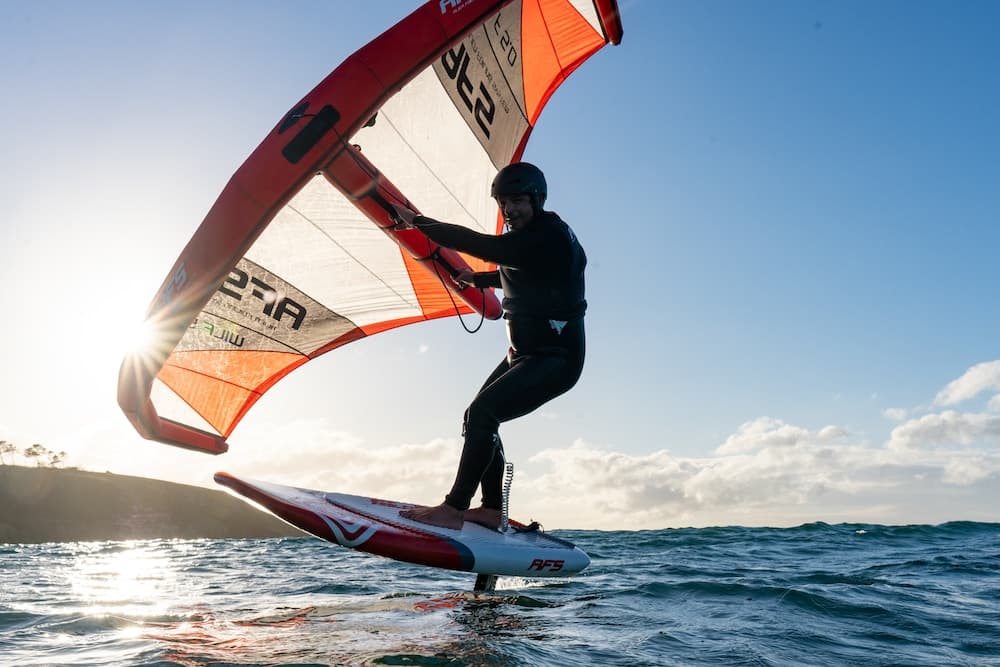
Are you looking for thrills, to disconnect, and to practice a sport unlike any other? Then wing foiling is for you! Recently appearing on our beaches (in 2019), it is THE water sport that is accessible to everyone and won’t put you in danger. Your sail, also known as a wing, is your engine. It gives you the speed you need to generate lift, which in turn activates your foil and gives you that unique gliding sensation that wingfoilers crave…
What exactly is wingfoil, this incredible water sport?
Wingfoil is a gliding sport practiced on the water, with the help of the wind. It consists of an inflatable wing, a foil and a board. You’ll also need wing and board leashes, a neoprene wetsuit, a helmet and, for your own safety, an impact vest.
Unlike windsurfing and kitesurfing, the special feature of the wing foil is that it flies about 30cm above the water. Only the bottom of the foil is submerged. The glide is ultra-fluid and silent, with very little friction on the water: a real treat!
Thanks to the wind blowing into the wing, the board gradually gains speed, and the foil gradually lifts it out of the water. Experienced wingfoilers can fly from 10-12 knots. As for beginners, they need a stronger wind, around 16-20 knots, ideal for learning the magic of wing foiling.

The wing is held directly by the rider’s hands using handles, or sometimes a wishbone. There is no mast like in windsurfing, nor lines like in kitesurfing. A leash, connected to the wing, will prevent you from losing it (a cord attached to the wrist to prevent losing the wing). When it comes to choosing a comfortable wing, the AFS D-LITE is perfect for getting started in wingfoiling. It is a stable and easy-to-maneuver sail for beginners. In short, the AFS D-LITE offers exceptional maneuverability, progressive power, and impressive ease of use.
The board is obviously under our feet for stability. Its volume (measured in liters) and size (measured in feet) vary depending on our weight and skill level. The shape is also important. A leash is attached to the rider, either around their waist or ankle. Two high-quality boards from our AFS brand are recommended for beginners: the AFS Fly One and the AFS Fire.
And finally, the foil, which includes the plate (attached to the board), the mast (made of carbon or aluminum), and the wing (made of carbon and consisting of the fuselage, front wing, and stabilizer). This is what enables you to fly and stabilizes you in the air, which is called lift. Our recommendation for beginners is the AFS Flyer foil.
Wingfoiling is growing dramatically in popularity at many spots today. The number of people practicing it continues to multiply. Indeed, it gives us immense pleasure. And the rapid evolution of increasingly high-performance equipment is making this water sport more and more accessible today. Even for those who are new to board sports. AFS foiling is at the cutting edge of technology when it comes to equipment for beginners to wingfoiling. All feedback is welcome to ensure that AFS equipment is accessible to all practitioners, including beginners.

What does the wing for wingfoiling look like?
Choosing the right wingfoil is crucial for every outing on the water. It also ensures maximum comfort for your arms. The wing is what generates speed in the first place, propelling you above the water’s surface with the help of the foil.
In most cases, a wing foil sail is made up of two inflatable bladders and a variety of sewn, waterproof fabrics. This includes the spinnaker cloth. The arcuate bladder is the leading edge, and gives the wing its shape. The middle bladder, which separates the two symmetrical windows, is called the central batten. And it’s on this flange that you’ll find the handles for holding the wing foil. They’re useful for controlling and steering the wing – it’s a bit like your rudder. Handles can be rigid, with a plastic coating, or soft, with a fabric coating. The latter are often recommended for beginners, to avoid bumps or horny hands.
Never forget to attach the leash to your wing, so that you don’t lose it in the event of a fall, and so that you can return to the starting point.
With the exception of sails sold in wing foil packs, the wing is not sold with a pump. So you’ll need to think about getting a suitable one.
What size wing should I choose to start wing foiling?
Different wing sizes are available on the wing foil market, offering a wide range of choices. The great thing is that there’s something for everyone. It doesn’t matter what your level, weight, size, or bicep size is! Wing foil sail surfaces are usually between 3 m² and 6 m². And there are smaller and larger sizes available. You can try them out during our tests before investing.
Be careful when choosing your wing, as one that is too small will make takeoff difficult. On the other hand, a wing that is too large will be more complicated to maneuver and control.
4 m² is the ideal size for sailing in winds of 15 to 25 knots for those weighing no more than 75 kg. For heavier sailors, opt for a 5 m² or even 6 m² sail for 100 kg to be comfortable. When you first start wing foiling, you usually only have one wing. It is important to know where to sail. Some people do it on lakes, others at sea. Wing foiling can be practiced in an area where the prevailing wind is often strong or, conversely, in an area where the wind is very light. Or even unstable wind. It is therefore necessary to choose your single wing carefully.
For more frequent practice, and depending on the conditions, we strongly recommend that you expand your quiver to two or even three wingfoils, so you don’t miss any sessions on your favorite spots. A 2-square-meter difference if you have two wings: e.g. 3 and 5 m² for a 75-kilo wingfoiler and 3 and 4 m² for a 55-kilo wingfoiler. Or 4 and 6 m² for someone weighing 90 kilos or more.
If you’re lucky enough to have three wings, take a square meter between each of them.
With new technologies, the materials used in wing foil sails are not all the same. At AFS foiling, for example, we use spinnaker cloth that is lightweight, strong and ultra-high-performance. This is the case with the D-LITE in our AFS range, perfect for beginners. And at a price you can afford on the wing foil market.
Where to launch your wingfoil?
Don’t know where to get your first wingfoil tacks?
The ideal situation is undoubtedly to learn to sail on a body of water where the wind blows crosswise, with very little chop and sandy bottoms if you are at sea. The flatter the water, the easier it will be for you to stand up on your board and then fly. Obviously, avoid waves!
On the other hand, choose a spot that is not very busy if you have the opportunity! This will allow you to focus on learning without fear of collisions or being bothered by other people on the water, or any obstacles.
Let’s talk about wind strength! Between 16 and 22 knots, it will be much easier for you to leave the surface of the water. Without tiring yourself out or overworking your arms, and even less so without pumping. And if you’re lucky enough to have a closed body of water (lake or pond) near your home, that’s even better for learning wing foiling, as you can avoid drifting out to sea.
The weight and surface area of a wing foil are extremely important for good sailing. Especially when you’re learning, as you spend a lot of time on your knees on the board. His arms are even more forced to hold the wing slightly above his head, just long enough for him to stand up. And this experience lasts a little longer than that of an experienced rider, making the choice of kite – in terms of construction and surface – all the more essential.
Saving your energy before takeoff (lifting the board out of the water) is important, especially if you’re planning on spending two hours out on the water. Once you’ve mastered this step, all that’s left to do is glide and fly… And enjoy an absolutely exceptional ride!
As you can see, getting started with wing foiling requires, above all, a sail that is suited to your level and the weather conditions! With the right wing foiling equipment in your hands, your desire to improve will only grow. So don’t hesitate to come and test out AFS gear at our upcoming events. You’ll also get the best advice from our team.
And if you haven’t started learning wingfoiling yet, there’s still time to head to a spot and take a course; many sailing schools offer them.
