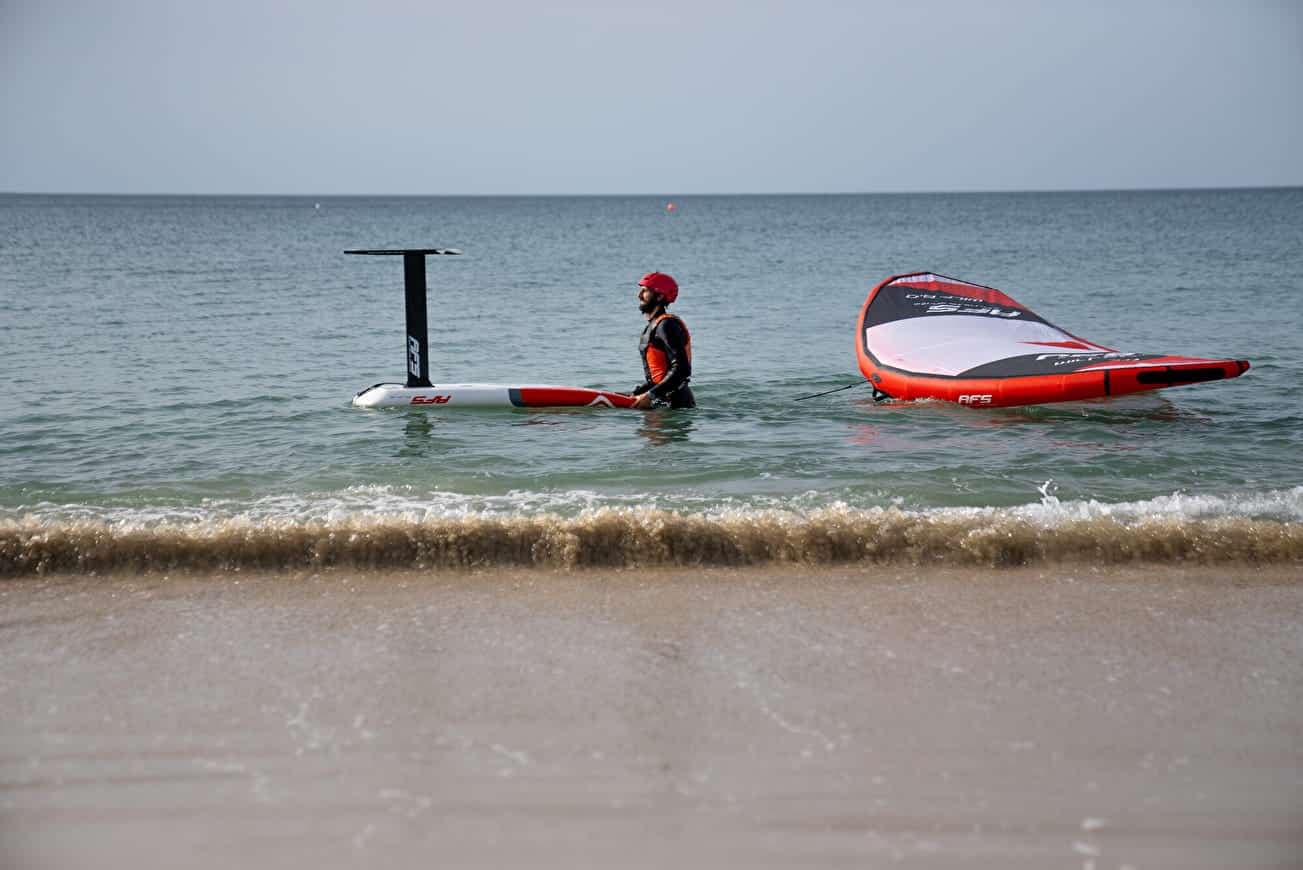
Foil: should you choose carbon or aluminum? We recommend carbon. It’s lighter, it allows a thinner profile, and it doesn’t corrode. Aluminum usually costs less up front and handles knocks well. But it’s heavier and needs more care. That holds true for wing foiling, surf foiling and towed foiling alike. At AFS, every mast we make is carbon. You’ll find the full range on our All foils page.

What’s the difference between a carbon foil and a foil with an aluminum mast?
A foil is made of a mast, a fuselage, a front wing and a stabilizer. On a so-called “aluminum” foil, it’s usually the mast, the baseplate and the fuselage that are aluminum. The front wing and the stabilizer are most often still carbon.
At AFS, every mast is carbon. Our only aluminum part is a fuselage. Here’s what changes, point by point.
| Criteria | Carbon | Aluminum |
|---|---|---|
| Weight | Lighter. Our 68 cm (26.8 in) carbon fuselage: 560 g (1.2 lb) | Heavier. Our 68 cm (26.8 in) aluminum fuselage: 960 g (2.1 lb) |
| Profile | Thinner for the same stiffness | Thicker for the same stiffness |
| Corrosion | Doesn’t corrode | Corrodes in salt water |
| Care | Fresh-water rinse | Careful rinse, especially the screw inserts, plus sand removal |
| Impacts | Doesn’t stay bent, but more sensitive to hard impacts | Takes knocks better, but can stay bent |
| Purchase cost | Usually higher | Usually lower |
Does a carbon mast perform better than an aluminum one?
To match the stiffness of a carbon mast, an aluminum mast has to be thicker. So carbon allows a thinner profile, which glides better.
Weight and stiffness also matter on takeoff. A lighter, stiffer setup gets up on foil sooner, and the ride feels more responsive. A stiff mast also helps you when pumping.
Material isn’t everything: design counts too. On our HR masts, the carbon fibers run at 0° along the length for bending stiffness, and at about 45° for torsional stiffness.

How much does a carbon foil weigh?
Take our carbon Flyer Full Set with the 1800 front wing. The front wing weighs 1,000 g (2.2 lb), the 85 cm (33.5 in) HR mast 1,700 g (3.7 lb), the fuselage 560 g (1.2 lb) and the stabilizer 200 g (0.4 lb). The whole setup comes in at about 3.5 kg (7.7 lb).
To see the effect of the material alone, compare our two 68 cm fuselages. They’re the same length and have the same section thickness (32.5 mm, 1.28 in). The carbon one weighs 560 g (1.2 lb), the aluminum one 960 g (2.1 lb): 400 g (0.9 lb) more for that one part.
You feel that weight saving when you carry your gear to the spot. You feel it on takeoff too.
Do an aluminum mast and fuselage corrode in salt water?
Aluminum doesn’t rust, but it does corrode in salt water. After every session, rinse it with fresh water, especially the screw inserts. Clear the sand out of the connections too.
Carbon doesn’t corrode. The screws are still metal, so rinse your foil with fresh water to keep the connections free of sand and prevent corrosion. That’s all the care it needs.

Do carbon foils break easily?
A carbon mast won’t stay bent after an impact, while an aluminum mast can deform for good. On the other hand, carbon is more sensitive to hard impacts, like hitting a rock or a hard bottom.
After a big hit, check your mast and wings. Look for a crack or a chip, especially near the baseplate and the connections. If in doubt, stop riding it and contact us.
Do you need a carbon foil to start?
It’s not required, but we recommend it. It’s lighter, it gets up on foil more easily, and you keep the same foil as you progress. To start wing foiling, we recommend the Flyer Full Set. It combines a large front wing, an 85 cm (33.5 in) HR carbon mast, a carbon fuselage and a U-Cruise stabilizer.
For your front wing size, or if your discipline isn’t wing foiling, use our foil finder: your weight, your level and your discipline are all it takes. For the rest of your gear, read what equipment you need to start wing foiling.

Which carbon mast should you choose?
Our masts come in four constructions: HR, HM, UHM and UHM Skinny. All of them are carbon. From one range to the next, what mainly changes is the profile thickness, so the glide, and the price.
The right mast depends on your weight, your front wing size and your priority: budget or glide. To find yours, use the “Which mast?” step of our foil finder. The four ranges are detailed in our AFS mast comparison.
Carbon or aluminum for your discipline?
The choice of material doesn’t depend on your discipline. Carbon is lighter and doesn’t corrode, whether you ride surf foil, wing foil or towed foil. If you ride in the ocean, the corrosion advantage matters even more. What changes from one discipline to another is the mast length and the front wing size.
Frequently asked questions
Is carbon or aluminum better for a hydrofoil?
For most riders, carbon. It’s lighter, it allows a thinner profile for the same stiffness, and it doesn’t corrode in salt water. Aluminum costs less up front and takes knocks well, but it’s heavier and needs more care.
Is a carbon mast worth the extra cost?
If you ride often, and especially in the ocean, yes. You get a lighter setup, a thinner profile that glides better, and no corrosion to deal with. You also keep the same mast as you progress.
Does AFS sell aluminum parts?
Yes, just one: the aluminum fuselage. It’s 68 cm (26.8 in) long and built to be robust. All our masts are carbon, and the Flyer Full Set comes with a carbon fuselage.
Can a carbon foil be repaired?
It depends on the damage. Send a repair request with photos: you’ll get a quote by email within 2 business days. Don’t ship the part before you accept the quote. Repairs can take up to 30 days after the part reaches our workshop.
Where can I buy a used carbon foil?
On our used gear marketplace.
What warranty comes with an AFS foil?
All our products come with a 2-year warranty. For returns, see our terms of sale. Our foils are made in France, at our factory in Brittany.
Carbon or aluminum, the right foil is first the one that fits your weight, your level and your discipline. Try the foil finder, then compare models across the full range of AFS foils.