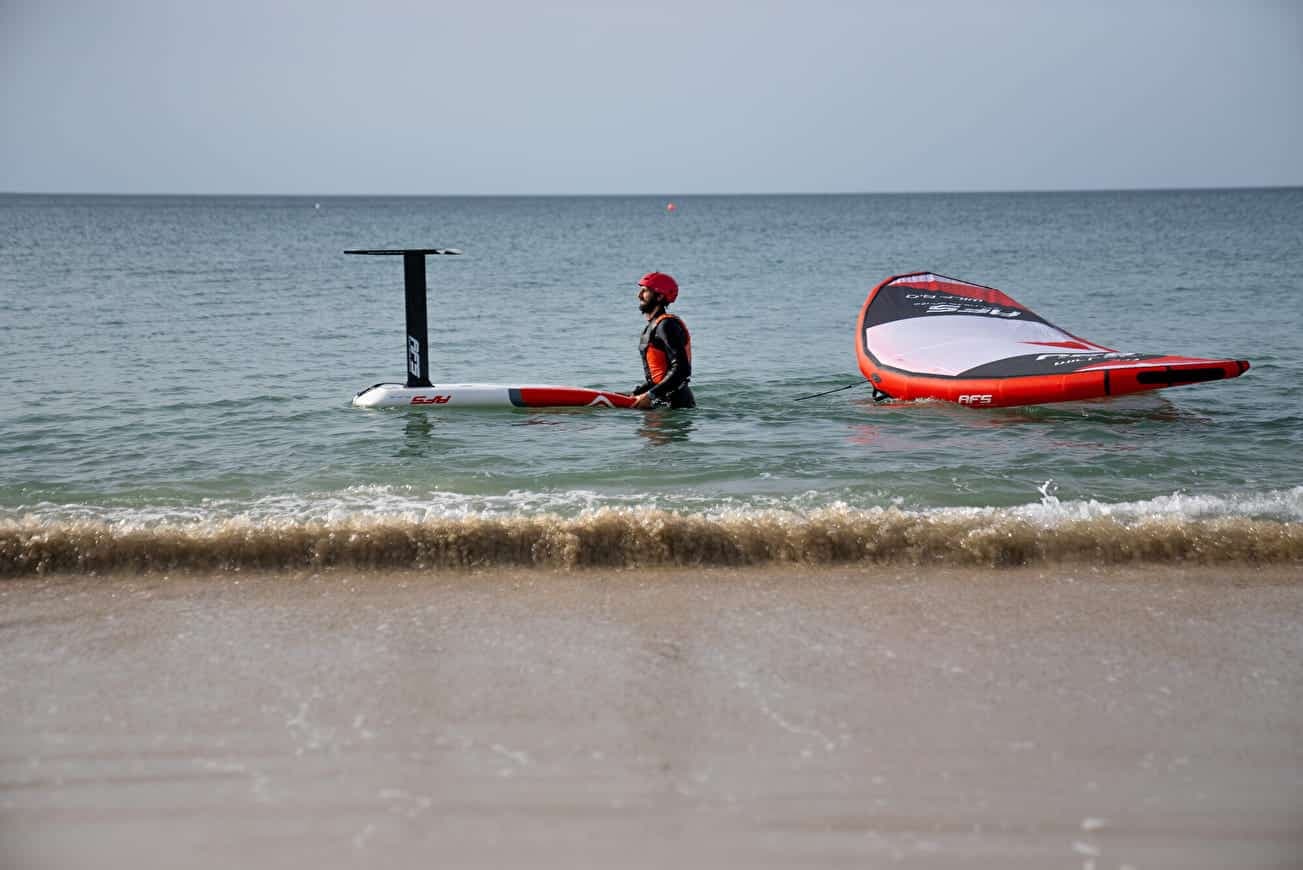
To start wing foiling, you need four things: a high-volume board, a wing, a stable foil with an 85 cm (33.5 in) mast, and some safety gear. The right sizes depend mostly on your weight. This guide gives you one setup: the one we recommend.
For your foil, the fastest way is our Foil Finder: enter your weight, level and riding style, and you get the foil we recommend (front wing, stabilizer, mast). All the gear is on our wing foil equipment page.

What equipment do you need to start wing foiling?
The beginner setup AFS recommends:
| Item | Our pick | Example for 65 kg (143 lb) |
|---|---|---|
| Board | Fly One | Size based on your weight (see below) |
| Wing | D-Lite, wing leash included | 4 m² |
| Foil | Evo Foil Full Set, 85 cm carbon mast | Evo 1450 front wing |
| Add-ons | Pump with pressure gauge and board leash | Same for every rider |
Add a helmet, an impact vest and a wetsuit. AFS doesn’t sell them.
What board do you need to start wing foiling?
When you start, volume helps you stand up and get going without strong wind. For beginners, we recommend the Fly One. It’s a rigid wing foil board, built in PVC sandwich and fiberglass, with inserts to mount your foil. It weighs 6.3 to 7.2 kg (13.9 to 15.9 lb) depending on size.
| Size | Volume | Length | Width |
|---|---|---|---|
| S 5’8″ | 90 L | 173 cm (5’8″) | 61 cm (24 in) |
| M 6’0″ | 105 L | 182 cm (6’0″) | 63 cm (24.8 in) |
| L 6’2″ | 115 L | 189 cm (6’2″) | 65 cm (25.6 in) |
| XL 6’4″ | 125 L | 193 cm (6’4″) | 66 cm (26 in) |
If you’re a complete beginner, here is the size we recommend for your weight:
- under 65 kg (143 lb): 5’8″, 90 L;
- 65 to 75 kg (143 to 165 lb): 6’0″, 105 L;
- 75 to 85 kg (165 to 187 lb): 6’2″, 115 L;
- over 85 kg (187 lb): 6’4″, 125 L.
The Fly One tops out at 125 L. If you weigh more than 95 kg (209 lb), ask an AFS expert.
Inflatable or rigid? AFS only sells rigid boards. For more on volume, read which board to choose to start wing foiling, or browse all our boards.

What size wing should a beginner get?
For beginners, we recommend the D-Lite. It comes with a leash, a bag and a repair kit. Pick the size based on your weight:
| Your weight | D-Lite size |
|---|---|
| Under 75 kg (165 lb) | 4 m² |
| 75 to 90 kg (165 to 198 lb) | 5 m² |
| Over 90 kg (198 lb) | 6 m² |
We recommend these sizes for 10 to 25 knots of wind. For your first sessions, look for steady wind between 15 and 20 knots. Above 25 knots, conditions get dangerous for a beginner.
More on wind ranges: which wing for which wind speed and which wing to choose as a beginner. All our wings are on the wings page.
What foil do you need to start wing foiling?
For beginners, we recommend the Evo range with an 85 cm (33.5 in) mast. Evo front wings are built for progressive takeoffs and stable flight. The Evo Foil Full Set comes with its 85 cm HM carbon mast and its stabilizer.
What front wing size for your weight?
Our size guide for the Evo front wing, beginner level. Buy the front wing in the “light wind” column: that’s the one for your first sessions. The right-hand column is for wind above 20 knots.
| Your weight | Front wing, light wind | Strong wind (over 20 knots) |
|---|---|---|
| Under 60 kg (132 lb) | Evo 1250 (1,250 cm² / 194 in²) | Evo 1250 |
| 60 to 75 kg (132 to 165 lb) | Evo 1450 (1,450 cm² / 225 in²) | Evo 1250 |
| 75 to 90 kg (165 to 198 lb) | Evo 1650 (1,650 cm² / 256 in²) | Evo 1450 |
| Over 90 kg (198 lb) | Evo 1650 | Evo 1650 |
If you’re building your foil part by part, use the Foil Finder: we recommend the stabilizer and mast that match your front wing.
What mast length for beginners?
85 cm (33.5 in). That’s the length we recommend for the “beginner, freeride” style.
Aluminum or carbon?
Our masts are carbon: AFS doesn’t sell aluminum masts. Our foils are made at our factory in Brittany, France. To compare our masts, read how to choose the right AFS carbon mast. To go further on front wing sizes: what size foil to choose for wing foiling.
What accessories do you need to start wing foiling?
- Pump with pressure gauge: you need it to inflate your wing. It isn’t included in our packages. AFS wing pump.
- Wing leash: included with the D-Lite.
- Board leash: it keeps your board close after a fall. AFS board leash.
- Helmet and impact vest: certified gear protects you from hits by the board or the foil. AFS doesn’t sell them. Read our advice on wing foil hazards.
- Wetsuit: pick it based on the water temperature at your spot. AFS doesn’t sell them.
- Later on: footstraps and a carrying case.
All our accessories: wing foil accessories.

Complete package or separate gear?
For your very first rides, put your setup together as shown above. Our Pack Evo is built for riders who already have a good foundation and want to progress fast. The pump isn’t included. All our packages are on the wing foil packages page.
Looking for used gear? Check out our marketplace.
How do you learn to wing foil?
Take lessons at a school: it’s the safest way to learn how to handle the wing, the right-of-way rules and safety. Starting from scratch, plan on about twenty hours at least before you fly and keep your balance over several yards.
For your first sessions:
- flat or slightly choppy water;
- steady wind between 15 and 20 knots, side-shore or side-onshore;
- never offshore wind: it pushes you out to sea;
- always tell someone before you go out on the water.
To find where to learn, read where to learn wing foiling. Next steps: handling the wing, standing up, then riding upwind.
Buying from AFS
- Foils made at our factory in Brittany, France.
- 2-year warranty on all our products.
- 14-day returns, return shipping at your expense (terms and conditions of sale).
- Not sure about your setup? Ask an AFS expert.
FAQ: wing foiling for beginners
What equipment do you need for wing foiling?
A board, a wing, a foil (front wing, stabilizer, fuselage and mast), a pump, a board leash and a wing leash. Add a helmet, an impact vest and a wetsuit. Our recommended setup is in the table at the top of this guide.
What size foil should a beginner use for wing foiling?
With the Evo front wing, in light wind: 1250 under 60 kg (132 lb), 1450 from 60 to 75 kg (132 to 165 lb), 1650 above 75 kg (165 lb). For your full foil, use the Foil Finder.
What size wing should a beginner get?
With the D-Lite: 4 m² under 75 kg (165 lb), 5 m² from 75 to 90 kg (165 to 198 lb), 6 m² above.
What size board do I need for wing foiling as a beginner?
A high-volume board helps you stand up and get going in light wind. Our pick is the Fly One. For a complete beginner, we recommend the 5’8″ (90 L) under 65 kg (143 lb), the 6’0″ (105 L) from 65 to 75 kg (143 to 165 lb), the 6’2″ (115 L) from 75 to 85 kg (165 to 187 lb) and the 6’4″ (125 L) over 85 kg (187 lb). Above 95 kg (209 lb), ask an AFS expert.
What mast length is best for beginners?
85 cm (33.5 in): that’s our recommendation for beginners.
Do I need a pump?
Yes. It isn’t included in our packages. Get our pump with pressure gauge.
Is wing foiling hard to learn?
It takes patience. Starting from scratch, plan on about twenty hours at least before you fly over several yards.
Can you learn wing foiling on your own?
Lessons at a school are still the safest option. After that, never go out on the water without telling someone. See where to learn wing foiling.
Can you start with used gear?
Yes. You can find used AFS gear on our marketplace.
Ready to gear up? Find all our wing foil equipment.