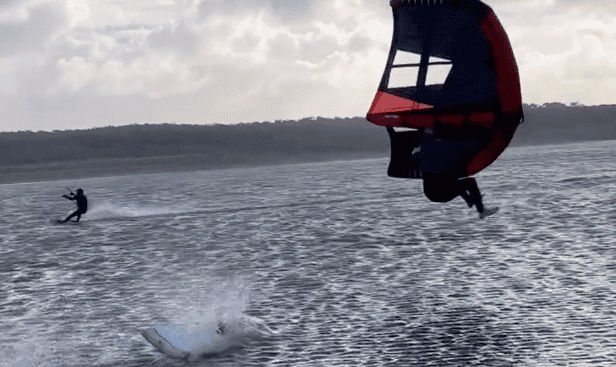
Wingfoiling is an exciting water sport that is practiced outdoors, in an environment that is not necessarily our own: on the water and vast expanses such as the sea, the ocean, and large lakes! We are then connected to Mother Nature, who must be respected. And we must also know how to deal with this environment and sometimes confront it if we do not follow certain rules.
Wingfoiling is a sport that anyone can enjoy and does not present any obvious dangers that are immediately apparent (except, of course, in the event of a storm). However, a poorly prepared session can sometimes end badly.

What are the dangers of wing foiling?
Wingfoil is guaranteed adrenaline, but beware of the risks! The type of spot, the weather conditions, the equipment and the level of the rider are all decisive factors for safe practice.
Safe surfing means surfing calmly and avoiding any problems! Whether you are a beginner or an expert in wingfoiling, it requires a strong sense of responsibility: both for yourself and for others present at the spot (those practicing wingfoiling or other board sports, swimmers, or even walkers and beachgoers near the water).
- Wing spot
Sailing on crowded or obstructed waters can be uncomfortable and dangerous. Beware of shallow areas, rocks and reefs, which can damage your equipment and cause accidents. There can sometimes be a lot of people on the water, and not necessarily just in wings. Especially in summer. Don’t forget that boaters, kitesurfers,
There are also tides to take into account at certain spots, particularly on the Atlantic coast. A falling tide can create counter-currents, while a rising tide can generate powerful waves breaking close to shore (shorebreak).
- Weather and environmental conditions
Natural elements such as wind and currents have a significant impact on wingfoil safety. An offshore wind can easily carry you out to sea, making it difficult to return if you are not proficient at riding upwind. In addition, unexpected waves can cause more falls and increase fatigue. That’s why it’s important to stay informed about the weather forecast. You can do this on your phone or computer using apps such as Windguru, Winds-up, Windy, and others. You can also talk to other riders on the beach. In addition, you need to carefully observe the water and everything around you. The basis for any session is knowing how to read both the horizon and the beach. Often, we are in a hurry to get out on the water because we don’t have time… Or simply because we have a crazy desire to ride and enjoy the intense pleasures of wing foiling! We then neglect the most important thing: studying our playground. Wing foiling is a discipline that requires a certain amount of vigilance.
- Material
The foil can cause serious injury in the event of an uncontrolled fall. Be careful of cuts. Impact with your board can also cause trauma or fractures. To avoid a lot of falls and a lot of hassle, choose your wingfoil equipment according to your level without rushing things. A board with a minimum of 40 liters more than your weight + a foil equipped with a front wing of 1600 to 1800 cm² (depending on your size) + a wing with a surface area of 4 m² for lighter riders and 5 m² for heavier riders so as not to be overpowered. It’s better to be a little overpowered than underpowered. But don’t go overboard! The sail is your engine, so you need surface area to take off and maintain your flight.
- Errors in practice and lack of preparation
Poor knowledge of safety instructions and inadequate preparation can lead to accidents. For example, an incorrectly mounted foil or an over-inflated (or under-inflated) wing can cause problems.
Another tip is to learn the rules of priority: remember that “starboard tack” means that the rider on the right side of the wind has priority to pass (right arm out). Another essential rule is that the rider “downwind” has priority: that is, the rider furthest from the wind direction if two riders are receiving the wind from the same side (same tack) at that precise moment. Finally, the rider who is being overtaken by another rider also has priority; the rider catching up must therefore move out of the way.
For more experienced wingfoilers learning to jump, do not jump near others or too close to the edge of the beach, so as not to injure anyone else. Also, do not ride too close to each other. There is no such thing as zero risk.
Even with more advanced wingfoiling skills, you can still be caught off guard by waves breaking on the shore without even having time to climb onto your board. Always position yourself between the breaking waves and your board. The wing is in the air and held by the upwind hand. The other hand holds the board.
In addition, for a better session and to limit mistakes (sometimes silly ones), it is necessary to take a few breaks. By pushing yourself too hard, you can sometimes injure yourself on a simple jibe. Or even when trying a new aerial maneuver. Get out of the water for a few minutes, drink some water, and take the opportunity to rest… And get back in shape!
To navigate safely, it is important to be aware of your wingfoil skill level and anticipate risks.
Which spot to choose when you start wingfoiling?
Choosing the right spot is essential for wingfoiling. It has to be adapted to your skill level, as well as to the configuration of the spot. Whether you’re just starting out or already a little
1. Spots for beginners
For beginners, it is recommended to choose flat (or slightly choppy) water and a steady light to moderate wind, between 15 and 20 knots. Preferably a crosswind (side shore or side onshore). This wind direction allows you to sail safely, without the risk of drifting out to sea. Protected beaches with few waves and sufficient water depth (approximately 1.50 to 2 meters) are ideal for avoiding most risks. The condition of the water is essential for safe sailing. Make sure that it is indeed an authorized sailing area. Some areas are not, and buoys or a channel indicate this. Especially during the summer.
2. Wind conditions and safety
Wind is a key factor in choosing the right spot. A wind that is too strong or from an unfavorable direction (onshore wind) can lead to dangerous situations, such as losing
What precautions should I take with my wing?
As explained above, the weather and the type of spot need to be analyzed before taking to the water. Before any wingfoil session, check both technical and safety equipment.
- Equipment setup
Basically, opt for a wing, foil and board that are adapted to your level.
The adjustment must be done correctly. Incorrect adjustment of your equipment can affect safety and put you in danger if you have not checked it properly.
Your wing must be inflated to the correct pressure, as indicated on the pressure gauge of your pump when you inflate it. If it is overinflated, it may burst while you are flying. If it is underinflated, you may not be able to fly and therefore have difficulty returning to your starting point on the beach.
Each screw on the foil must be tightened securely. A properly mounted foil and a mast positioned correctly under the float will optimize your equipment… and therefore your sailing. Too much weight on the rear can hinder you if you are a beginner. Position your foil in the middle or slightly forward on the rail so that you can take off with less effort.
- Choosing the right safety equipment for the right protection
The helmet and impact vest are essential safety accessories. The vest protects you in the event of a fall and also provides additional buoyancy for the rider. It’s a bit like a life jacket, but less thick. As for the helmet, which must be certified (like the protective vest), it protects you from impacts with the board or foil. This prevents possible cuts. Once in flight, the faster you go, the more brutal the fall is likely to be. Wing foiling is an “extreme” board sport. So protecting yourself well means limiting the dangers.
Other safety features include leashes. Scratches must be properly tightened around the wrist and waist (or ankle). Their respective knots (board leash and wing leash) must be secure. Also, the small cord attached directly to your board’s plug and the one attached to your wing should have a little slack in case the knot slips. In addition, the board leash should be long enough in case the rider is thrown off, so that they can land far away and avoid falling directly on their equipment. Remember to replace each leash after a significant number of uses. Don’t wait until it breaks while you’re riding, or you risk seeing your wing fly away or your wing foil board drift away without you, leaving you without your gear, worse still, out at sea. This also applies on land! Don’t leave your inflated wing kite unattended without attaching it to either your board, a heavy object, or something else anchored to the beach or parking lot. Taking care of your gear before, during, and after your session is an extra safety measure for us as wingfoil riders.
Finally, remember to wear a wetsuit and neoprene boots suitable for the water temperature. The wetsuit helps prevent hypothermia. It also provides additional protection against abrasions and in the event of a fall or impact.
| Neoprene wetsuit | Prevents hypothermia during extended periods on the water + extra protection against impacts, whatever the season |
- Know your level and limits
Beginners and intermediate practitioners must respect the fundamentals of wingfoiling to avoid putting themselves in danger and disturbing other riders who may be kitesurfing, windsurfing, dinghy sailing, etc. Or even swimmers in the sailing area.
Don’t overestimate your abilities! When wing foiling, if you don’t follow certain safety rules and priorities, you can easily hurt yourself (or someone else) or drift off course. Taking lessons at a sailing school to learn the basic techniques, such as the different points of sail (sailing upwind, for example), wing control, and foil management, is the best solution. This significantly reduces risks and dangers and will make you feel much more comfortable when you’re alone on the water. With the help of your instructor, you will know what equipment to buy after learning how to adjust your gear, the rules of safety and priority, and of course how to plane and fly with a wing foil.
As a result, more and more riders are carrying a simple cell phone in a waterproof pouch. This can be useful in case of problems, especially for wingfoilers who practice downwind riding. This involves sailing offshore from point A to point B (i.e., without returning to the launch point but rather to another final destination, with the wind at your back). In addition to an impact vest, helmet, leashes, and phone, riders are required to carry a waterproof backpack with drinking water, food, and a distress flare. They can also add a signaling mirror and a whistle. If you have a smartwatch, wear it! (or another type of GPS device). Another tip: downwinders must notify the CROSS (Regional Operational Center for Surveillance and Rescue) before any outing of this kind. Maritime regulations define a maximum distance of 2 miles from a coastal shelter.
Always take the time to check all your equipment. But also check the environment before you start wingfoiling… So you can enjoy it to the fullest. This is the basis for optimal safety, in order to reduce accidents. Responsible and well-prepared practice can significantly reduce risks.
On the other hand, never abandon your wingfoil board, even when you’re in trouble. It’s a bit like a life jacket or a buoy. It’s better to paddle back on it than to swim back without anything.
Above all, always let someone know when you’re going out on the water, even if it’s just for an hour. And the name of the spot you’re going to! Wing foiling is even more awesome when you do it as safely as possible!
