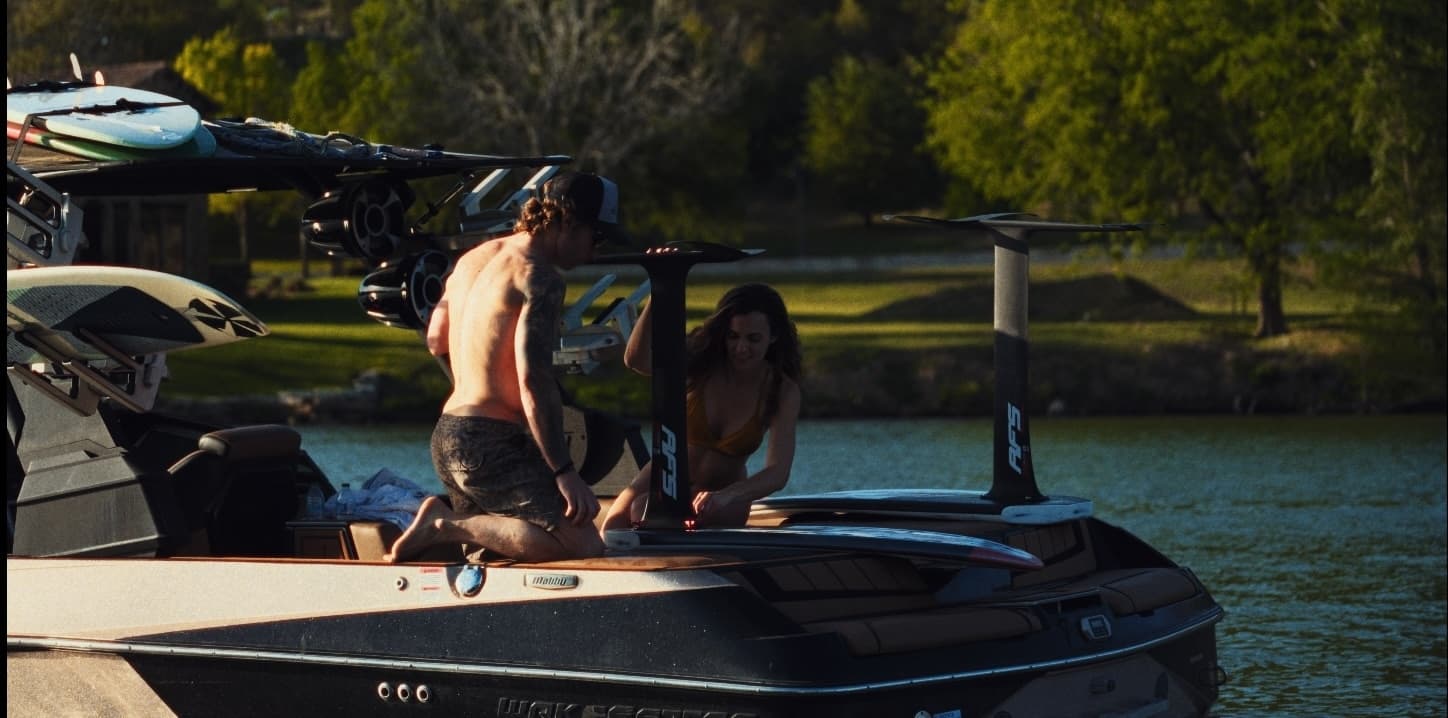
Wake surf foiling means riding the wave a boat leaves behind it on a foil board, without holding the rope once the wave carries you. Below: how it differs from towed wake foiling, the foil setup we recommend and how to stay safe near the boat. To see the gear, start with our wake foil range.
What is wake surf foiling?
It is surf foiling behind a boat. The boat makes a wave. You ride that wave on a foil, the way you would ride a wave in the ocean. Some riders use the rope to get up, then let it go. Others start without it.
The names are loose. Some riders say “wake foil” for both styles, others say “wakesurf foil”. In this article, wake surf foil means riding the boat wave without the rope.
Wake surf foil vs towed wake foiling: what is the difference?
The foil works the same way. What changes is what moves you forward.
| Criteria | Towed wake foiling | Wake surf foiling |
|---|---|---|
| Rope | You hold it the whole ride | Let go once the wave carries you |
| What pushes you | The boat, through the rope | The wave behind the boat |
| What you need from the boat | A steady pull | A wave clean enough to ride |
Most riders get comfortable flying on the rope before they try riding without it.
What gear do you need for wake surf foiling?
The foil
Behind a boat, you turn often. For wake foiling, maneuverability matters more than glide or stability. That is why we recommend one setup: a Silk V2 front wing on an 85 cm mast.
The Silk V2 comes in six sizes, from 650 to 1,150 cm². The right size depends on your weight and your level: a beginner rides a bigger wing, an expert a smaller one. Use the Foil finder, pick Wakefoil as your discipline and enter your weight and level. For rope-free riding, book a call with an AFS expert to confirm your size. Check availability on the product page before you order.
Our foils are made in France, in our factory in Brittany. All our products come with a 2-year warranty.
The board
The Pulse is our compact wake foil board: 4’0″, 19 L, 3.3 kg (7.3 lb). It is built for towed riding, with inserts to set your straps where you want them. Riding the wave without a rope, often without straps, asks for a different board. Talk to an AFS expert before you choose one.
Safety gear
We recommend a helmet and an impact vest from your very first session. An impact vest is not a life jacket: check which flotation the rules on your water require. Read our guide on how to choose a helmet and an impact vest.
How do you go from the rope to the wave?
- Fly on the rope first. Get up, fly level and turn both ways while towed. Do not drop the rope before this feels easy.
- Agree on the plan with the crew. Decide before you start what happens to the rope when you let go, and how you signal to the driver.
- Move into the wave. Still on the rope, find the spot where the wave starts to push you.
- Let go when the wave carries you, as agreed with the crew.
- Stay in the wave. Small moves up and down the wave face help you keep your speed.
Expect to fall at the start. Practice falling away from the foil in easy conditions.
How should you set up your foil for wake?
- Mast: 85 cm, the length we recommend for wake foiling.
- Front wing: a Silk V2, in the size the Foil finder gives for your weight and level.
- Stabilizer and fuselage: choose them with an AFS expert.
- Boat speed and wave shape: they depend on the boat, its ballast and its load. Start slow and adjust with the driver. Your boat manufacturer is the right source for its wave settings.
Is wake surf foiling dangerous? Safety near the boat and the propeller
A foil is a rigid blade under your board. It can cut and cause a serious injury in an uncontrolled fall. Behind a boat, you also have the hull and the propeller to think about. A few habits keep the risk down:
- Stay clear of the propeller. Before you swim toward the back of the boat or climb aboard, agree with the driver that the engine is off.
- Have someone watch you. A person on board keeps an eye on you, so the driver can focus on driving.
- Agree on signals before you start: faster, slower, stop, “I’m OK” after a fall.
- Do not fight the board when you fall. Jump away from the foil, and keep clear of the boat.
- Keep your distance from swimmers, docks and other boats.
- Never ride alone. If you are new to foiling, take lessons with a qualified instructor, and follow the rules that apply on your water.
For more on falls and gear, read our article on foil safety and falls.
FAQ
Can you wake foil without a rope?
Yes. The wave behind the boat can carry you once you are in its push. You need a wave strong enough and enough control on foil to stay in it.
What is the difference between wake foiling and wake surf foiling?
In towed wake foiling, the boat pulls you with the rope for the whole ride. In wake surf foiling, the wave behind the boat pushes you and you ride without the rope.
Do I need a special boat?
You need a boat that makes a wave clean enough to ride. Ask your boat’s manufacturer or dealer how to shape it.
What speed should the boat go?
There is no single speed. It depends on the boat, its ballast and the wave you want. Start slow and adjust with the driver.
What size foil do I need for wake surf foiling?
We recommend a Silk V2 front wing on an 85 cm mast. The wing size depends on your weight and level: enter them in the Foil finder.
Do I need to know how to foil first?
It helps a lot. Learn to fly on the rope first. If you have never foiled, take lessons with a qualified instructor.
Where can I find used wake foil gear?
Check the AFS marketplace, where riders sell their used gear.
What about warranty and returns?
All our products come with a 2-year warranty. For returns, see our terms of sale.
Ready to set up your foil for the boat? Browse our full wake foil range, or book a call with an AFS expert to choose your setup.