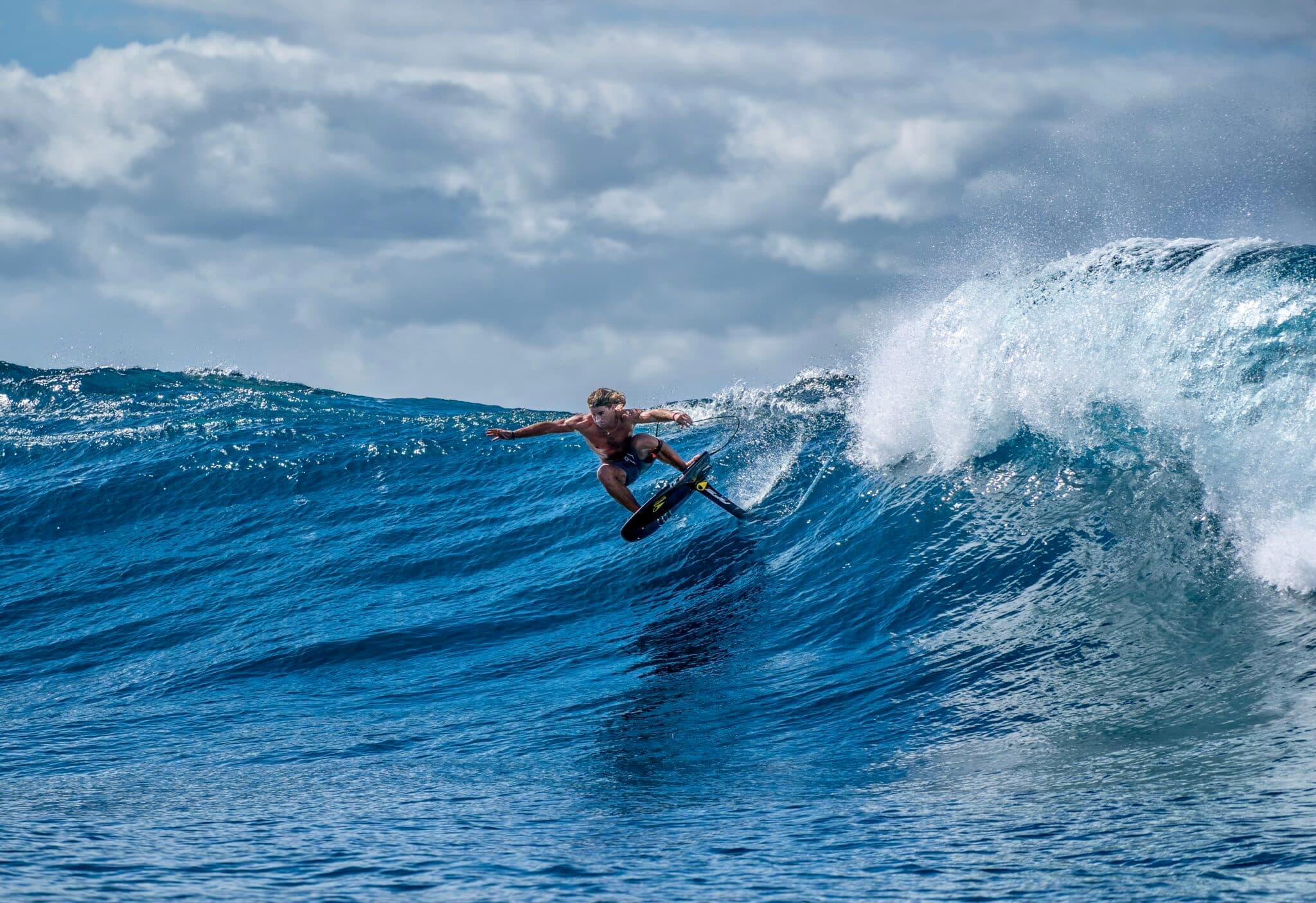
To get started with surf foiling, you’ll need a front wing that’s big enough for your weight, an 80-cm mast, and a high-volume board. Then, there are three steps: choose easy waves, learn to take off facing the beach, and develop the right reflexes when the foil slips out of your control. The rest is just a matter of spending time on the water. And to find the right kite size in 20 seconds, the surf foil simulator does the math for you.
How does a surf foil work?
A foil consists of a front wing, a stabilizer, a fuselage, and a mast, all attached to the bottom of the board via a mounting plate. To fly, you need speed—either from a wave or the wake of a boat. You then push down with your back foot, the front wing tilts up and generates lift: the board rises.
To lower yourself, shift your weight forward. To raise yourself, push down on the back. Once airborne, the foil reacts to the slightest pressure. That’s why a rigid foil helps so much: it does exactly what you ask it to do—nothing more.
Equipment for Beginners
The front wing. This is the most important factor. In foil surfing, you want about 870 cm² for 70 kg and 970 cm² for 80 kg—a little larger if your waves are small. A larger wing takes off sooner and is more forgiving.
At AFS, the Silk V2 is our surf foil wing (ranging from 650 to 1150 cm², comes with the U Surf fin).The Enduro, with its longer aspect ratio, is very effective for pumping; in the 800 or 900 sizes, it’s ideal for surf foiling in light conditions.
Once you’ve got your front wing, the stab matters just as much for your low end: see our guide on choosing a U-Surf or U-Carve stab with your Silk V2.
The mast. 80 cm is the recommended length for foil surfing. To position it on your board, read our article on adjusting the foil mast.
The board. Start with a board that has more volume: you’ll paddle more easily and be more stable when taking off. The Single F (40 or 50 L, mid-length) is designed for that. The Chipri Legacy, which is shorter, will come into play once you’re comfortable on the foil. Wondering what a mid-length board is? We explain everything in “What Is a Mid-Length Board?”
Not sure what size you need? The surf foil simulator calculates your setup based on your weight and skill level.
Choose your conditions and your spot
Start out in easy conditions: a gentle wave, or just the surf, with few people around. Ideally, look for a long wave with deep water so you can learn safely. Avoid the shore break: a foil and a wave breaking on the sand don’t mix well.
If you have access to a boat, its wake is a great place to practice gliding before you head out into the waves.
The Takeoff, Step by Step
That’s where surfers get caught off guard: their reflexes no longer work.
- Start facing the beach, perpendicular to the waves.
- Don’t tilt the board sideways when the wave starts pushing you. When foiling, you take off straight, just like an airplane.
- Put your front foot well forward—even if it seems like too much: that’s where you generate the most lift.
- Accept a different stance: at first, it’s normal for your front foot to be farther apart than usual. It helps you control the foil.
Your First Flights and the Safety Instinct
Remember this golden rule: never fight against the foil’s movement. If you’re aiming left and the foil veers right, your instinct as a surfer will be to push hard to bring it back on course. Bad idea: you’ll only accentuate the turn and often end up with a hard fall. The right reflex is to let go and throw yourself in the opposite direction of the foil. The other safety rules are the same as for wing surfing: we go over them in detail in “How to Avoid Accidents While Foiling.”
Once you’re in the air, your turns start with your head: look where you want to go, open your shoulders, lead with your arms, and your body will follow. There’s little room for error: use light, precise movements—never abrupt ones.
Pumping: Riding One Wave After Another
Pumping allows you to stay airborne after the wave and return to the peak without paddling. Here’s how it works: you push off with your back leg to lift the front of the board, then shift your weight to your front leg to generate lift again. The secret is to be light and fluid—don’t force it. It takes technique and a bit of cardio, but that’s what makes foil surfing so addictive. To learn more, read our complete guide to foil pumping.
Common Mistakes
- Hold the board at an angle during the takeoff, just like in surfing.
- If you keep your front foot too far back, the board won’t take off.
- Push against the foil instead of letting go of it.
- Starting with a wing that’s too small or a board that’s too short.
- Choose a spot with a shore break or one that’s too crowded.
Frequently Asked Questions
Do you need to know how to surf to try surf foiling? It helps with reading the waves, but there are several surfing habits you need to break, starting with taking off at an angle.
What size wing is best for beginners? About 900 cm² for a 75 kg rider, a little more if your waves are small.
Can you surf with a foil in small waves? Yes, that’s actually the point: you can save sessions where regular surfing doesn’t work.
Does surf foil help with wing foil? Yes: You’ll learn how to manage lift, your stance, and pumping—all of which are useful in every foil discipline.
Further Reading
Check out the full line of AFS foil surf gear, including the simulator that calculates your setup. Our foils are 100% carbon, made in France, and come with a 2-year warranty. And if you’re not sure which size to choose, an AFS expert will help you for free.