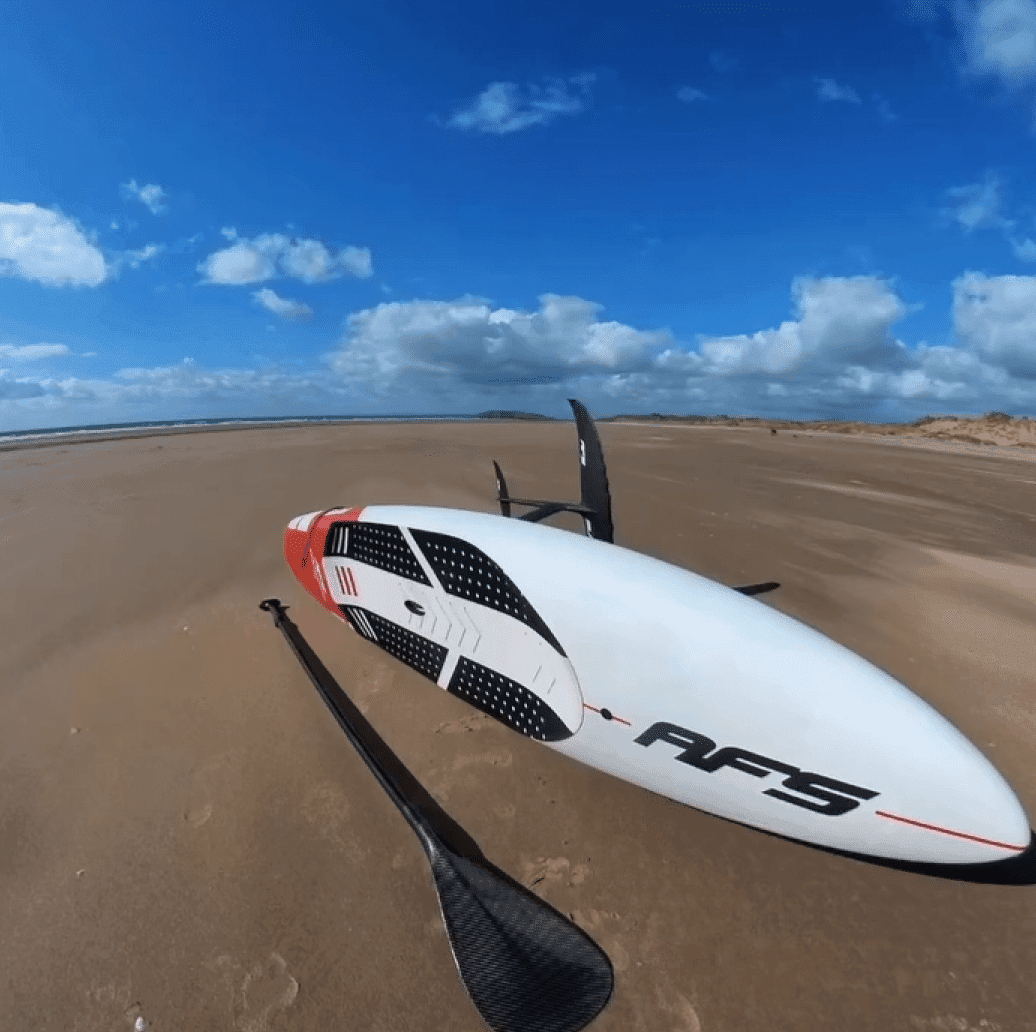
A mid length foil board is narrower and a bit longer than a standard wing foil board of the same volume. It gets up on foil early and pumps well. At AFS, the Blackbird mid lengths run from 5’2″ to 6’3″ (161 to 190 cm) and from 19″ to 22.5″ wide (48 to 57 cm). They are built mainly for wing foil, and also for parawing, SUP foil and surf foil.

What is a mid length foil board?
The name comes from surfing. A mid length sits between a shortboard and a longboard. In foiling, the idea is the same: longer and slimmer than a compact wing board, shorter than a downwind board.
The clearest way to see it is to compare two AFS boards with the same volume:
- Fly One 5’8″, a compact wing foil board: 90 L, 173 cm (5’8″) long, 61 cm (24″) wide;
- Blackbird Mid-Length 6’0″: 90 L, 182 cm (6’0″) long, 55 cm (22″) wide.
At the same volume, the mid length is 9 cm (about 3.5″) longer and 6 cm (about 2.4″) narrower. The volume is spread over a slimmer board.
What the shape changes
The Blackbird Mid-Length gives you quick take-off, linear acceleration and efficient pumping. Pumping is the leg motion that keeps the foil flying with no wind or wave. The Carbon version takes off quickly in light wind.
Mid length vs. compact wing board: the numbers
| Compact wing board | Mid length | |
|---|---|---|
| AFS example | Fly One | Blackbird Mid-Length |
| Length | 5’8″ to 6’4″ (173 to 193 cm) | 5’2″ to 6’3″ (161 to 190 cm) |
| Width | 24″ to 26″ (61 to 66 cm) | 19″ to 22.5″ (48 to 57 cm) |
| Volume | 90 to 125 L | 50 to 100 L |
| Disciplines | wing foil, all levels | wing foil, parawing, SUP foil, surf foil |
Why ride a mid length?
- Earlier take-off. It’s the first strength of both Blackbird boards.
- Easier pumping. You keep flying through the lulls between gusts. For the technique, read how to pump on a wing foil.
- One board, several disciplines. The Blackbird Mid-Length is designed for wing foil, parawing, SUP foil and surf foil.
- A step toward downwind. It also works for downwind. To get into it, read the introduction to downwind.
The trade-offs
- Size. At 161 to 190 cm (5’2″ to 6’3″), it takes more room in the car than a short board.
- Stability at rest. A narrow board is usually less stable at the start than a wide one.

Is a mid length good for beginners?
For your first sessions, a wide board is more stable at the start. To make that first choice, read which board to choose to start wing foiling.
If you want a mid length from day one, go for high volume. To start wing foiling on a Whitebird Mid Length, we recommend the 6’6″ (100 L) under 80 kg (176 lb) and the 6’8″ (115 L) above. The compact Blackbird sizes, 5’4″ (65 L) and 5’8″ (82 L), are made for lightweight or experienced riders.
Blackbird Mid-Length sizes
| Size | Volume | Length | Width | Board weight |
|---|---|---|---|---|
| 5’4″ × 19″ | 65 L | 163 cm | 48.3 cm | 5.3 kg (11.7 lb) |
| 5’6″ × 20.5″ | 75 L | 167 cm | 52 cm | 5.6 kg (12.3 lb) |
| 5’8″ × 21.5″ | 82 L | 173 cm | 54 cm | 6.0 kg (13.2 lb) |
| 6’0″ × 22″ | 90 L | 182 cm | 55 cm | 6.1 kg (13.4 lb) |
| 6’3″ × 22.5″ | 100 L | 190 cm | 57 cm | 6.6 kg (14.6 lb) |
Fiberglass / carbon version.
The two new sizes, 5’4″ (65 L) and 5’8″ (82 L), are compact and responsive: we recommend them for lightweight or experienced riders. The Carbon version adds a 5’2″ at 50 L.
The right volume depends on your weight, your level and your spot. For the foil underneath, use the AFS foil finder: answer a few questions and we recommend a setup based on your weight, level and discipline. For the board, an AFS expert can help you for free: ask an AFS expert.
AFS mid length boards
Blackbird Mid-Length (fiberglass / carbon)
PVC sandwich with fiberglass and carbon. Five sizes, from 5’4″ / 65 L to 6’3″ / 100 L. The 5’4″ and 5’8″ are new this season.
Blackbird Mid Length Carbon
The mid length shape from the AFS Advanced range, in PVC and carbon sandwich. Six sizes, from 5’2″ / 50 L to 6’3″ / 100 L. It is lighter: 4.1 to 5.8 kg (9.0 to 12.8 lb) depending on size. Its length-to-width ratio is inspired by the Blackbird downwind board. To understand the two constructions, read AFS and AFS Advanced board construction.
See the Blackbird Mid Length Carbon
Whitebird Mid Length (end of line)
PVC sandwich with fiberglass and carbon. Three sizes: 5’8″ / 85 L, 6’6″ / 100 L and 6’8″ / 115 L. It is made for light wind, downwind and SUP foil, with recommended wing foil sizes by level.
All AFS boards come with a 2-year warranty. You have 14 days to return a product, and return shipping is at your expense. To compare with other models, see all boards. Looking for a used mid length? Check the AFS marketplace.

What about surf foil?
Mid lengths also exist in surf foil (prone foil), where you paddle into the wave. They have less volume: the Single F comes in 5’4″ / 40 L or 5’8″ / 50 L. For dedicated boards and foils, see the surf foil category.
FAQ
What size mid length foil board do I need?
It depends on your weight, your level and your spot. For beginners, we recommend the Whitebird Mid Length in 100 L under 80 kg (176 lb) and 115 L above. The compact Blackbird sizes (65 L and 82 L) are for lightweight or experienced riders. If you are unsure, ask an AFS expert.
How long is a mid length foil board?
At AFS, 5’2″ to 6’3″ (161 to 190 cm) for the Blackbird models, and up to 6’8″ (203 cm) for the Whitebird.
Can you wing foil on a mid length?
Yes. Wing foil is the main use of the Blackbird Mid-Length, alongside parawing, SUP foil and surf foil.
What is the difference between a mid length and a regular wing board?
At the same volume, it is narrower and a bit longer. Example at 90 L: 55 cm (22″) wide for the Blackbird Mid-Length, 61 cm (24″) for the Fly One.
Mid length or downwind board?
The Blackbird Mid-Length also works for downwind. A dedicated downwind board is still longer. Read the introduction to downwind to get started.
Is a mid length good for beginners?
A wide board is more stable for your first sessions. If you still want a mid length, choose a high-volume size, such as the Whitebird Mid Length in 6’6″ or 6’8″.
Find boards, wings, foils and packages on the wing foil page.