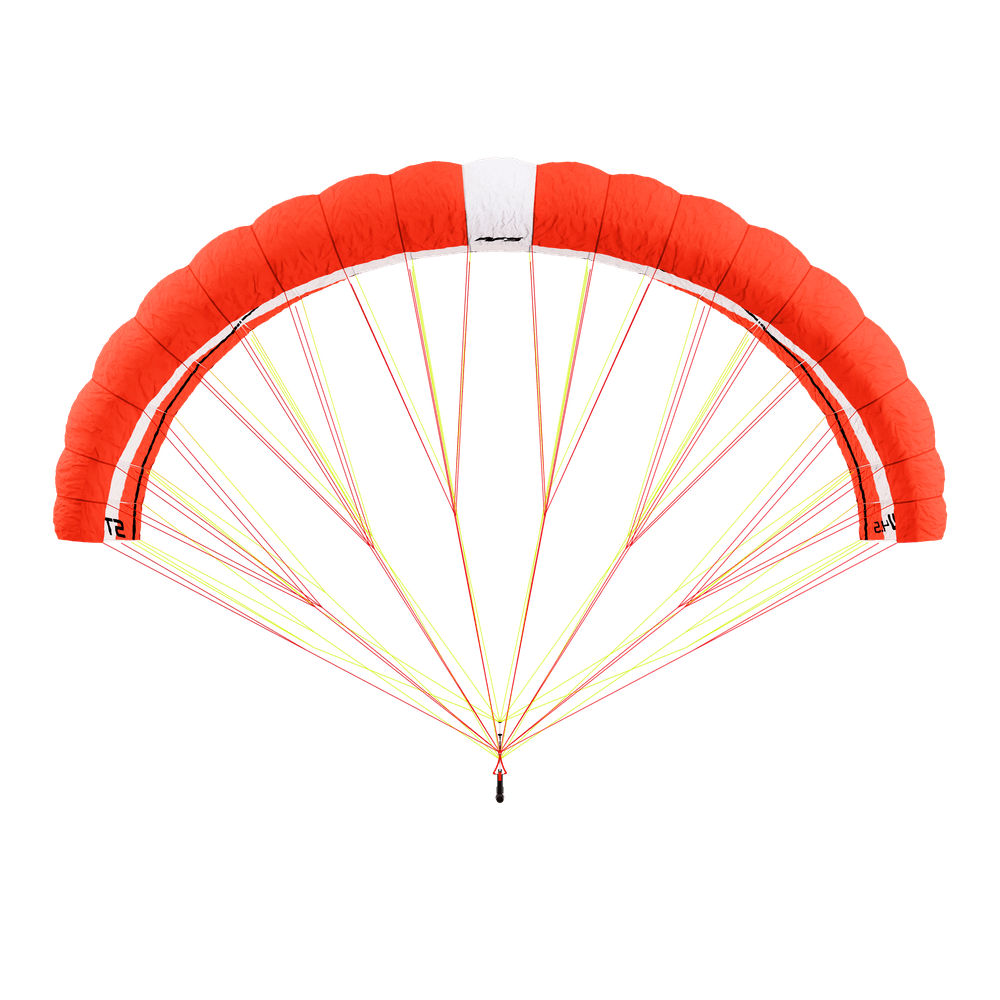
Parawinging means flying a small soft wing in your hands while you stand on a foil. You need a foil and a board built for beginners, and a wing sized for the day’s wind. All the gear is on our parawing page. Here we cover what you need to get started: the gear, getting to know your wing on land, and safety.
What is a parawing?
A parawing (sometimes called a pocket wing or low kite) is a small soft traction wing with cells and no inflatable frame. You fly it with a short bar or handles, attached by lines of 1.3 to 1.8 m (4 to 6 ft).
Do you need to know how to foil first?
Parawinging is done on a foil. If you have never flown one, take lessons with an instructor. Our article on where to learn wing foiling helps you pick a school and a spot. It is written for wing foiling, but the same tips apply to your first flights on a foil.
What gear do you need to start parawinging?
To get started, we recommend one setup: the Evo foil full set and the Fly One board for your weight, with the Stow sized to the wind at your spot.
Foil and board for your weight
Evo is the range we recommend for beginners. It comes with its HM 85 mast, stabilizer and fuselage.
| Your weight | Evo foil full set | Fly One board |
|---|---|---|
| under 60 kg (132 lb) | Evo 1250 | 5’8 (90 L) |
| 60 to 64 kg (132 to 141 lb) | Evo 1450 | 5’8 (90 L) |
| 65 to 74 kg (143 to 163 lb) | Evo 1450 | 6’0 (105 L) |
| 75 to 84 kg (165 to 185 lb) | Evo 1650 | 6’2 (115 L) |
| 85 kg (187 lb) and up | Evo 1650 | 6’4 (125 L) |
Already have a wing foil foil? Our parawing gear page tells you which front wings and masts work for parawing.
The wing: the Stow
The Stow comes in 2.5, 3.5 and 4.5 m². With the Stow, you change size with the wind. The 4.5 m² covers 12 to 25 knots, the 3.5 m² 15 to 30 knots and the 2.5 m² 25 to 40 knots. To find the right size for your spot, talk to an AFS expert.
The start is the most demanding moment in parawinging. The Stow’s Power Loop system reduces pull at that moment. Once you are up and flying, it extends the usable range in strong wind.
To check the foil and board for your weight, use the foil finder: enter your weight and your level.
Before the water: get to know your wing on land
Take time to learn your wing before you head out on the water.
- The color-coded bridles (the lines attached under the wing) show you the Stow’s orientation at a glance. They help you redeploy it the right way up.
- The arch bridle has no central element on the bar: your hands slide freely along its full length.
- The packing lines are thicker and spliced, so they are easy to grab when you fold the wing in a few seconds.
- A carry bag is included to store it.
For the moves on the water (starting, depowering, relaunching the wing), ride with an instructor.
Parawing safety for beginners
We recommend wearing a helmet and an impact vest from your very first session, with your board leash. Basic rule: never let go of your board. To choose your gear, read our article on wing foil helmets and impact vests.
Before every session, check your gear: wing, lines, bar, foil. Do not use damaged equipment.
Check the wind, the weather and the tide before you go. An offshore wind can carry you out to sea. Our article on wing foil hazards covers the right habits on the water: they apply to parawinging too.
Frequently asked questions
Do I need to know how to foil before I try parawinging?
It helps a lot. If you have never ridden a foil, start with lessons from an instructor. Our guide on where to learn helps you find a school.
What size parawing should a beginner get?
With the Stow, you pick the size by wind. The 4.5 m² covers 12 to 25 knots, the 3.5 m² 15 to 30 knots and the 2.5 m² 25 to 40 knots. For your spot, ask an AFS expert. The details are in our parawing size chart.
How much wind do you need to parawing?
It depends on the wing size. The Stow 4.5 m² covers 12 to 25 knots, the 3.5 m² 15 to 30 knots, and the 2.5 m² 25 to 40 knots.
What board do I need for parawing?
The Fly One for your weight: from the 5’8 (90 L) under 65 kg (143 lb) to the 6’4 (125 L) from 85 kg (187 lb). See the table above.
Where can I find a used parawing?
On our marketplace, rider to rider.
What warranty comes with AFS gear?
2-year warranty. For returns, see our terms of sale. Our foils are made in France, at our factory in Brittany.
Ready for your first session
An Evo foil and a Fly One for your weight, a Stow sized to the wind, a helmet and an impact vest: you are ready to start. To see all the gear, browse our parawing selection, or talk to an AFS expert.