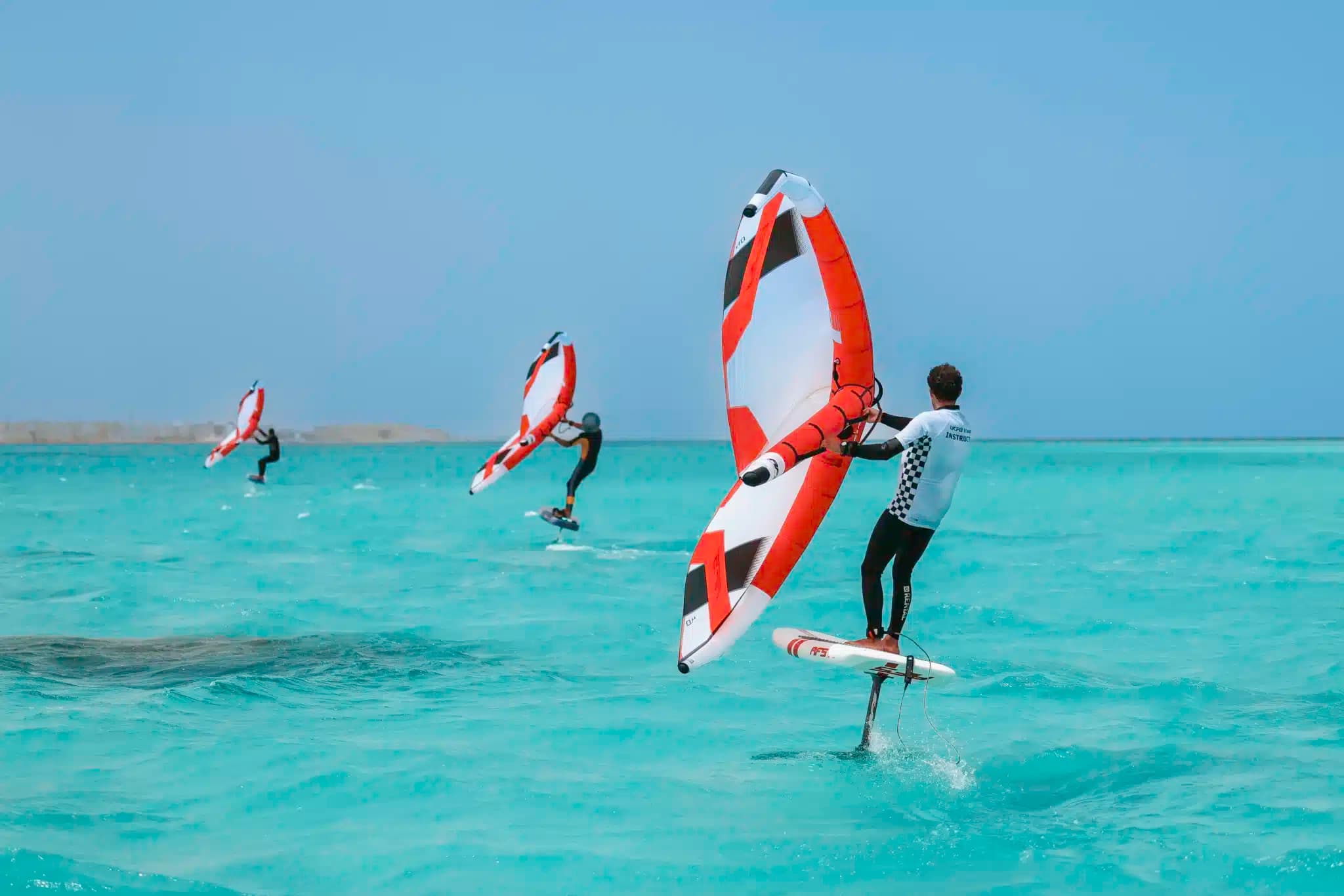
Every wing foil spot on the map
Filter by level or month. Click a spot to open its card in the guide to its area, where that area already has one.
Open the interactive map to explore the spots.
Looking for a wing foil spot near you, or a wing foil destination for your next trip? Here are our spots, sorted by area: France, Europe and the Canary Islands, and long-haul destinations. For each place, you’ll find where to learn, where to go once you progress and, when there is one, the AFS partner school on site. To get equipped before you leave, browse our foils, wings and boards in the wing foil category.
How to choose your wing foil spot
- Wind: to learn, aim for 15 to 20 knots. Below that, getting up on the foil is hard. Above it, it gets more technical and more tiring (choosing by wind).
- Direction: side shore or side onshore wind. Offshore wind, blowing from land to sea, can push you away from the beach very quickly: avoid it.
- Water: shallow but at least 1.5 m deep, sheltered and not crowded. Lagoons, lakes and protected beaches work well. Avoid rocks and obstacles (where to learn wing foiling).
- Tide: on the Atlantic and Channel coasts, many spots only work at certain times. A lagoon you can ride at mid-tide may empty at low tide.
- Local rules: in summer, many beaches require a launch channel through the swimming zone, and some towns or nature reserves ban foiling. Check locally before you go out.
- Safety: never ride alone, or tell someone you’re on the water. Wear a helmet and an impact vest.
Where to wing foil in France
Brittany
- North Finistère and the Bay of Brest: to learn, Sainte-Marguerite in Landéda, Roscanvel on the Crozon peninsula, sheltered from the swell, Les Blancs Sablons in Le Conquet, Trez Hir in Plougonvelin and Les 3 Moutons in Ploudalmézeau. In the bay, Moulin Blanc in Brest works well in south to south-west winds. For experienced riders, Le Dossen in Santec and Goulien in Crozon, two wave spots. AFS partner schools: AFS Foiling School and Brest Bretagne Nautisme at Moulin Blanc, and the sailing centres of Loperhet, Roscoff and Cléder.
- Bay of Morlaix: Carantec and Térénez, in Plougasnou, where the sailing schools teach wing foiling.
- South Finistère: La Torche for experienced riders, and Port-La-Forêt, in La Forêt-Fouesnant, to learn. La Laïta, between Guidel and Clohars-Carnoët, has flat water behind the river mouth, but only at high tide. AFS partner schools: La Torche Surf School, Kite Sardin School in Douarnenez, the Cap Sizun sailing centre in Audierne, Sainte-Marine in Combrit, Fouesnant, and Happy Foil in Concarneau.
- Morbihan: Saint-Colomban in Carnac and Kerhillio beach in Erdeven to learn, and the Gulf of Morbihan from Sarzeau for sheltered sessions. Quiberon Bay, protected from the swell, suits all levels; the Penthièvre point, on the ocean side, works in westerly winds. Plouharnel for experienced riders. AFS partner schools: the Arradon sailing centre, in the gulf, and the Étel sailing centre.
- Côtes-d’Armor: Lancieux and Saint-Cast-le-Guildo, both home to an AFS partner school.
Normandy and the Opal Coast
- Normandy: Houlgate, Ouistreham, Merville-Franceville, with the nearby Sallenelles bay, and Siouville to learn; Étretat, Le Havre and Dieppe for experienced riders. On the Cotentin coast, Granville and the shore from Bréhal to Jullouville host the French kite and wing foil championship in October 2026, and the downwind run from Chausey to Granville draws experienced riders. The La Hague sailing club also teaches wing foiling. AFS partner schools: Espace Voile Bréhal and the Cercle nautique de la Sinople in Quinéville.
- Opal Coast and Bay of the Somme: Wissant, between Cap Gris-Nez and Cap Blanc-Nez, the Boulogne-sur-Mer harbour and Le Crotoy, flat but only at high tide. AFS partner schools: Hotmer in Calais and Glisse Sensations in Mers-les-Bains.
Atlantic coast, from the Loire to the Basque Country
- La Baule: the main beach, Les Libraires, Plage Benoît in Le Pouliguen and Pornichet to learn; Les Jaunais in strong wind for experienced riders. To the north, Pont-Mahé in Assérac, where you can stand almost everywhere, is best around mid-tide. South of the estuary, Le Pointeau in Saint-Brevin-les-Pins hosts the schools.
- Noirmoutier and northern Vendée: Port de Morin in L’Épine, on Noirmoutier island, and the Notre-Dame-de-Monts water sports centre to learn; the Boisvinet base in Saint-Gilles-Croix-de-Vie offers lessons and rental from April to October.
- La Tranche-sur-Mer and southern Vendée: Plage Centrale, La Grière and the Belle Henriette lagoon to learn; Le Rocher and Les Générelles for experienced riders. La Chaume, in Les Sables-d’Olonne, has calm water to learn. AFS partner schools: the Cercle nautique tranchais and Wave School.
- La Rochelle and Île de Ré: Les Minimes, La Concurrence and Châtelaillon-Plage to learn; Aytré at high tide and La Pallice to go further. On Île de Ré, Rivedoux Nord is a shallow bay with no waves, best at high tide; Trousse-Chemise and Petit Bec suit all levels, and Diamond Head is a wave spot. AFS partner schools: CDV 17 and Moulin Mer Center in La Rochelle, the La Couarde sailing centre and Ré Glisse in Rivedoux.
- Oléron and Royan: the Anse de la Perroche, in Dolus-d’Oléron, to learn; Les Seulières beach in north-westerly winds for experienced riders. Near Royan, the Bonne Anse bay, in La Palmyre, is sheltered. AFS partner school: Saint-Georges Voiles, in Saint-Georges-de-Didonne.
- Arcachon: La Hume beach and Le Pyla, where sheltered lagoons form at low tide, to learn; Cap Ferret for waves and steady wind. Just south, the Cazaux-Sanguinet and Biscarrosse-Parentis lakes, with Gastes beach, are the fallback when the bay is too rough.
- Lacanau and the Médoc: Lacanau lake, from Le Moutchic, and the shallow Carcans-Hourtin lake, at Hourtin harbour or Bombannes, to learn without waves. The eastern part of Hourtin lake is closed to boats. La Nord beach, on swell days, for experienced riders.
- Hossegor and the southern Landes: Hossegor lake and Soustons lake, home to a dedicated wing foil school, to learn; offshore from La Gravière and Le Penon, in Capbreton, in strong wind for experienced riders.
- Hendaye and the Basque Country: the sheltered Txingudi bay to learn; the Grande Plage in strong wind for experienced riders. Several towns on the Basque coast, such as Saint-Jean-de-Luz and Anglet, have bylaws restricting foiling: check before you ride.
Mediterranean and Corsica
- Leucate and Le Barcarès: Le Goulet, on the Leucate lagoon, where the tramontane arrives first, and Port-Leucate on the lagoon side, in flat water, for all levels; Les Coussoules beach and La Franqui for experienced riders. The tourist office publishes a spot map. In Le Barcarès, the schools choose between the Salses-Leucate lagoon and the sea depending on the wind. On the lagoon, bring a weed fin.
- Gruissan and Narbonne: Les Chalets beach, Gruissan lake and the Mateille lagoon to learn on flat water; the Port beach and Les Cabanes de Fleury for experienced riders. In Narbonne, La Nautique base, on the Bages-Sigean lagoon, is open from March to November.
- Thau lagoon: Sète, Bouzigues, Balaruc and Mèze, where schools and clubs ride on the lagoon.
- L’Espiguette, La Grande-Motte and Montpellier: the Ponant lagoon, Le Couchant beach and Le Grand Travers to learn; the Espiguette point and the south beach of Port-Camargue in tramontane wind for experienced riders. Le Boucanet, in Le Grau-du-Roi, and the Carnon beaches work in westerly to southerly winds.
- Camargue and the Berre lagoon: the east beach of Saintes-Maries-de-la-Mer to learn; Beauduc for experienced riders, with zones closed from April to September to protect nesting birds. On the Berre lagoon, the Jaï base in Marignane, very windy in mistral, hosts a round of the regional wing foil championship.
- Marseille and Six-Fours: Pointe Rouge, in Marseille, in mistral, with lessons from March to December. In Six-Fours, La Coudoulière, Les Charmettes and Le Brusc for experienced riders, and Embiez island to learn.
- La Ciotat: mostly a spot for experienced riders, with the main spot and its swell in easterly winds; Plage Lumière and Les Capucins to learn.
- Hyères: L’Almanarre, La Capte, sheltered from the mistral, and La Badine lake to learn; the Salins d’Hyères, Giens and the Bergerie bay, in easterly winds, for experienced riders. Kitesurfing is banned at La Bergerie.
- Gulf of Fréjus and the Côte d’Azur: Saint-Aygulf, at the mouth of the Argens, with a south-westerly thermal from mid-March to early October; Les Issambres and Sainte-Maxime to learn all year round; Mandelieu-la-Napoule, further east.
- Corsica: in the south, Piantarella, a shallow lagoon facing the Lavezzi islands, La Tonnara and the Gulf of Figari, in Bonifacio and Figari, to learn; Balistra for experienced riders. Near Porto-Vecchio, Santa Giulia and Pinarello bay offer flat water. On the east coast, Ghisonaccia. In the north, Calvi and Algajola, in the Balagne, and Macinaggio, on Cap Corse, for swell and downwinders.
Lakes
- Lake Annecy: Sevrier, Les Marquisats, Saint-Jorioz and Doussard to learn in calm water with a regular thermal; Sevrier gets more technical on windy days.
- Lake Geneva: Thonon-les-Bains, Évian-les-Bains and Yvoire, on the French side, to learn; La Buvette in Thonon, the Cygnes beach in Évian and Excenevex in the north-easterly bise for experienced riders. The Swiss shore is covered in the Switzerland article.
- Serre-Ponçon lake: Chanterenne beach, in Crots, the windiest part of the lake, and Les Eaux-Douces beach, calm in the morning and windy in the afternoon. AFS partner school: Le Spot, at Chanterenne.
- Other lakes: Lac du Bourget, at the Grand Port of Aix-les-Bains, for experienced riders, as the wind is irregular; Lac de Sainte-Croix, at Bauduen and Les Salles-sur-Verdon, with a summer thermal; Lac du Der, in Champagne, where lessons are given with a boat.
Wing foil destinations in Europe and the Canary Islands
- Spain: Roses and Sant Pere Pescador, on the Costa Brava, to learn. In Tarifa, Valdevaqueros, sheltered by the dune, and Los Lances depending on the wind; Caños de Meca and Palmones are the fallback when the levante is too strong. La Manga del Mar Menor for experienced riders. Further north, the Ebro delta, at El Trabucador and Riumar, and Les Deveses, in Dénia, where you can ride all year round.
- Mallorca: the bays of Pollença and Alcúdia, with flat water and a summer thermal, and Can Picafort.
- Portugal: the Óbidos lagoon, about an hour from Lisbon, the Alvor estuary and Meia Praia, in Lagos, to learn; Cabedelo, in Viana do Castelo, with a flat lagoon next to the swell; Guincho and Figueira da Foz for waves.
- Sardinia: Punta Trettu, in the south-west, Porto Pino and Poetto, in Cagliari, to learn; Porto Pollo, in the north, Chia, in the south, Le Saline, in Stintino, and La Caletta, in the north-east, for experienced riders.
- Lake Garda, Italy: Torbole and Conca d’Oro with the afternoon Ora, all levels; Malcesine and Campione for the stronger morning northerly.
- Sicily and Puglia: Mondello, in Palermo, to learn with a thermal from April to October. In Puglia, Baia Verde in Gallipoli and the Punta della Contessa salt flats, near Brindisi, in sheltered water.
- Greece: Vassiliki, on Lefkada, Plaka on Naxos and Kefalos bay on Kos to learn; Prasonisi, on Rhodes, with flat water on one side and waves on the other, Pounda on Paros, Mykonos and Elafonisos for strong wind. The meltemi blows mostly in summer.
- Croatia: Bol, on Brač, calm in the morning and more demanding in the afternoon; Viganj, on the Pelješac peninsula, with a thermal from June to September; Cape Kamenjak, in Istria, to learn.
- Turkey: Alaçatı bay, flat water where you can stand for 500 m, with the summer meltemi.
- Switzerland: Versoix, Montreux and the Geneva shore of the lake, plus Lake Neuchâtel, to learn; Sisikon, on Lake Lucerne, for lessons. Lake Zurich and Lake Silvaplana, in the Engadine, with the Maloja wind in July and August, for experienced riders. AFS partner school: Tropical Corner, in Cologny.
- Austria and Germany: Lake Neusiedl, at Podersdorf, less than 2 m deep; on the Baltic, Fehmarn and Rügen, at Thiessow.
- Netherlands and Denmark: Brouwersdam and Bruinisse, on the Grevelingen, from late March to early November. In Denmark, the Ringkøbing Fjord at Hvide Sande to learn, Vandet Sø lake for beginners and Klitmøller, “Cold Hawaii”, for waves.
- Tenerife: El Médano to learn, and Playa del Medio, further north, in flat water; La Tejita and El Cabezo for waves and strong wind.
- Fuerteventura: Sotavento, Costa Calma, Jandía and Corralejo bay, with their flat water, to learn; Flag Beach and El Cotillo, when there is swell, for experienced riders.
- Gran Canaria: Las Canteras, Bahía Feliz and Bahía de Formas to learn; Pozo Izquierdo, Vargas, El Burrero and the Salinas de Tenefé, which have hosted international wing foil events, for experienced riders.
- Lanzarote: the La Santa lagoon, Las Cucharas, in Costa Teguise, and Playa Blanca, in the south, to learn; Famara and the outside of Las Cucharas for experienced riders.
Long-haul wing foil destinations
Wind depends on the season. Before you book, check the right period in the destination article and in when to go wing foiling.
French overseas territories
- Guadeloupe: the Saint-François lagoon, the island’s main wing foil spot, with its schools, and Le Gosier; Bois Jolan once you have the basics; Pointe des Châteaux and Le Moule for waves. The trade winds blow from November to July.
- Martinique: Anse Mitan to learn in light wind, Le Vauclin bay and Anse Michel, in Sainte-Anne, for all levels; Pointe Faula and Anse à l’Âne for experienced riders. The trade winds blow from December to July.
- Réunion Island: the Ermitage lagoon and Saint-Gilles bay to learn, and Saint-Pierre, where a club teaches wing foiling; Trois-Bassins and Saint-Leu for waves.
- French Polynesia: the Bora Bora lagoon, at Matira point, to learn; in Tahiti, Motu Martin and the south coast, from Maraa to Papeari. The wind is strongest from June to October. AFS partner school: Lakana Fly, in Moorea.
Africa and the Indian Ocean
- Dakhla: the shallow lagoon and the north lagoon beach to learn; Lassarga, flat on the lagoon side with waves on the ocean side, and the Speed Spot for experienced riders. The downwinder to Dragon Island is done at high tide, in northerly wind.
- Essaouira: the bay, near the harbour, with a north-easterly trade wind from April to October; Sidi Kaouki and Moulay Bouzerktoun for waves.
- Cape Verde: Kite Beach and Santa Maria bay, on Sal, for all levels; Ponta Preta, a reef wave for experts only.
- Egypt: the El Gouna lagoon, Soma Bay and Ras Soma Bay, a large shallow area, to learn; Safaga, Marsa Alam and Dahab for strong wind.
- South Africa: the Langebaan lagoon, in flat water, from August to April; Bloubergstrand and Big Bay, in Cape Town, with the south-easterly from October to March.
- Zanzibar: Nungwi, in the north, and the Kiwengwa lagoon to learn; Paje and Jambiani, also for experienced riders when the wind picks up.
- Mauritius: Flic en Flac, Blue Bay, Anse La Raie and the Kite Lagoon at Le Morne to learn; One Eye, Manawa and Bel Ombre, in the south, for experienced riders. The trade wind blows mostly from May to October.
Asia and the Middle East
- Dubai: Kite Beach, in Jumeirah, to learn; offshore from Kite Beach, in strong wind, for experienced riders.
- Sri Lanka: the Kalpitiya and Kappalady lagoons, and the Dream Spot in Dutch Bay, to learn; Vella Island, Mannar and Ippantivu island for experienced riders.
- Thailand: Koh Phangan, Koh Samui, with the Hua Thanon lagoon, and Pak Nam Pran, near Hua Hin, to learn; Klong Dao on Koh Lanta, Nai Harn in Phuket and Hua Hin for experienced riders.
- Vietnam: Mui Ne, in flat water from November to March; Phan Rang, further north, for experienced riders.
- Philippines: Bulabog Beach, on Boracay, with the north-east monsoon from November to April.
The Americas
- Brazil: on the north-east coast, Cumbuco, Preá and Paracuru for all levels; Jericoacoara and Taíba for experienced riders. The wind is strongest from September to January.
- Cabarete, Dominican Republic: Kite Beach, in flat water behind the reef, and Bozo Beach bay; Encuentro for waves. Watch out for sharp reefs.
- Mexico: La Ventana and El Sargento, in Baja California, from November to March; Isla Blanca, in Cancún, with waist-deep water. AFS partner school: Shaka Vibes, in Isla Blanca.
- Hawaii: Kailua Beach, on Oahu, Kanaha Beach Park and Kahului Harbor, on Maui, and Anini Beach, on Kauai, to learn; Ho’okipa, Spreckelsville and the Maliko downwinder, on Maui, for experienced riders.
- United States: Hood River, Oregon, with The Hook to learn and the Event Site for the summer thermal; Floras Lake, further south, and the sound side of the Outer Banks, North Carolina, to learn; Crissy Field, in San Francisco, for experts. AFS partner schools: Wingfoil Pro Center in Stuart, Florida, and Worldwinds in Corpus Christi, Texas.
Going in winter
When it’s cold at home, some destinations stay rideable. The winter wing foil spots article covers several, including Fuerteventura, Dakhla, Le Morne and Maui. Brazil, from September to January, and La Ventana and Cabarete, in winter in light wind, complete the list.
Find an AFS partner school
Our partner schools ride AFS gear. You can take lessons there or test a foil before you buy. Find them, along with our dealers, on the AFS map.
Frequently asked questions
Which wing foil spot is best for beginners?
Sheltered water, at least 1.5 m deep, with 15 to 20 knots of side shore or side onshore wind. Lagoons and lakes work well: the Leucate lagoon, Gruissan lake, Hossegor lake, Serre-Ponçon lake, the Dakhla lagoon, the Kalpitiya lagoon. For your first hours, a school is the easiest option.
Do you need to travel far to ride well?
No. France has spots for every level, from the Opal Coast to the Mediterranean, plus Corsica and the big lakes. Long-haul destinations are mainly for riding in warm water when the wind and the sea are cold at home.
Before you leave, browse our foils made in France, our wings and our boards in the wing foil category. Then pick your area, open your destination article and plan your next trip.