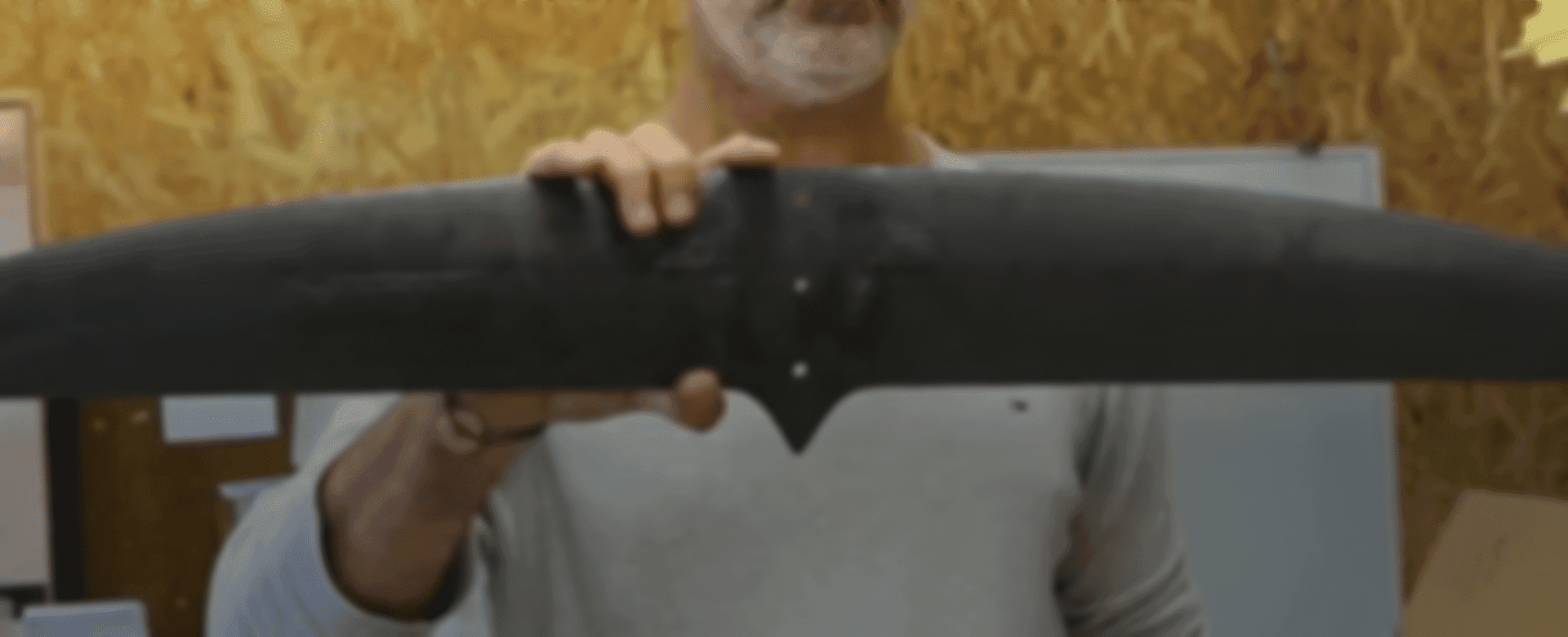
Aspect ratio describes the shape of a foil’s front wing: long and narrow, or short and wide. You get it by dividing the wingspan squared by the wing area. The lower it is, the more forgiving the wing. The higher it is, the better the wing glides, but it takes more skill to ride. It is a useful guide when you choose among our foil front wings.
What is aspect ratio on a foil?
Aspect ratio compares a wing’s span to its area. The span is the width from tip to tip. The chord is the width from the leading edge to the trailing edge. Two wings with the same area can look very different: one wide, with a lot of chord, the other long and narrow.
Think of a glider and a fighter jet. The glider has long, thin wings: it stays in the air for a long time. The fighter jet has short wings: it turns fast. A foil follows the same logic under water.
How do you calculate the aspect ratio of a foil wing?
Aspect ratio = span² ÷ area
The chord of a foil wing changes from the center to the tips. So you can’t simply divide the span by the chord. You use the area instead, which comes down to using an average chord. On a square, span and chord are equal: the aspect ratio is 1.
Keep the same unit for both: span in cm and area in cm², or span in inches and area in square inches. The result is the same. Our spans are listed in mm: divide by 10 to get cm. 980 mm = 98 cm.
Example with the Ultra 600: 980 mm of span, or 98 cm, and 600 cm² of area. 98 × 98 = 9,604. 9,604 ÷ 600 = 16. In inches: 38.6 in of span and 93 sq in of area. 38.6 × 38.6 ÷ 93 = 16.
Same math for the Evo 950: 88 cm of span, 950 cm². 88 × 88 ÷ 950 = 8.1.
Aspect ratio of AFS front wings
Here are our front wings, from the lowest aspect ratio to the highest.
| Front wing | Areas (cm²) | Spans (mm) | Aspect ratio | Designed for |
|---|---|---|---|---|
| Flyer | 1430 and 1735 | 955 and 1050 | 6.3 | Learning |
| Evo | 950 to 1640 | 880 to 1110 | 7.5 to 8.1 | Progressing, in all conditions |
| Pure Fuselink | 600 to 880 | 708 to 900 | 8.4 to 9.6 | Wing foil freestyle and freerace |
| Silk V2 | 650 to 1150 | 765 to 1017 | 9 | Carving and waves |
| Enduro | 600 to 1300 | 813 to 1190 | 11 | All-around: waves, swell, wing foil |
| Enduro GLT | 1600 | 1323 | 11 | Dock starts, flat-water starts, first downwinders |
| Evo HA | 750 and 1000 | 1000 and 1100 | 12.1 to 13.3 | Wing foil glide, freeride |
| Ultra | 600 to 900 | 980 to 1120 | 14 to 16 | Downwind and pumping |
A size name is not always the exact area. The Flyer 1500 is 1430 cm² and the Flyer 1800 is 1735 cm². The Evo 1250, 1450 and 1650 are 1240, 1440 and 1640 cm². The Pure 900 is 880 cm².
Does a higher aspect ratio mean more span?
Yes, but only when the areas are close. Compare three wings from 900 to 950 cm²:
- Evo 950: 880 mm of span, aspect ratio 8.1.
- Enduro 900: 994 mm, aspect ratio 11.
- Ultra 900: 1120 mm, aspect ratio 14.
On the other hand, every Enduro has the same aspect ratio of 11. The span grows with the area: 813 mm for the 600, 1190 mm for the 1300. Aspect ratio describes the shape, not the size.
High aspect vs low aspect: what changes on the water?
High aspect ratio
The wing has less drag and glides farther. It helps you with pumping and with connecting from one bump to the next. That is why downwind and pumping wings are long and narrow. The trade-off: it doesn’t turn as tight and takes more skill to ride.
Low aspect ratio
The wing is easier to handle and more forgiving. It forgives stance mistakes and turns easily. That is what you want when learning, and for tight turns in the waves.
Which aspect ratio fits your riding?
- You are learning: a low aspect ratio, like the Flyer or the Evo.
- You surf waves and want to carve: a medium aspect ratio, like the Silk V2 or the Enduro.
- You downwind or pump: a high aspect ratio, like the Ultra. To get started, read our guide on how to start downwind foiling.
Aspect ratio is only part of the choice. Area matters just as much: it depends on your weight, your riding and your level. For sizes, read our guides what size foil for wing foiling and what size front wing for surf foiling.
The easiest way: use the foil finder. Answer a few questions on your riding, your weight and your level, and we recommend a wing and a size.
FAQ
What is aspect ratio in simple terms?
It tells you how long and narrow a wing is compared to its size. A high number means a long, thin wing. A low number means a short, wide wing.
How do you calculate the aspect ratio of a foil?
Divide the span squared by the area, in the same unit. Example: Enduro 900, 994 mm or 99.4 cm of span, 900 cm². 99.4 × 99.4 ÷ 900 = 11.
Is a high aspect foil faster?
Not by itself. A long, narrow wing has less drag and glides farther, which helps you with pumping and with connecting from one bump to the next. To choose, area matters as much as aspect ratio.
What aspect ratio is best for beginners?
A low aspect ratio. The Flyer has the lowest aspect ratio of our wings (6.3). It is designed for learning and progressing.
What is the difference between area and aspect ratio?
Area tells you the size of the wing. Aspect ratio tells you its shape. Two wings with a similar area can have very different aspect ratios, like the Evo 950 (8.1) and the Ultra 900 (14).
Now you know how to read the aspect ratio of a wing. Compare models and specs on our foil front wings page, or start the foil finder to find yours.