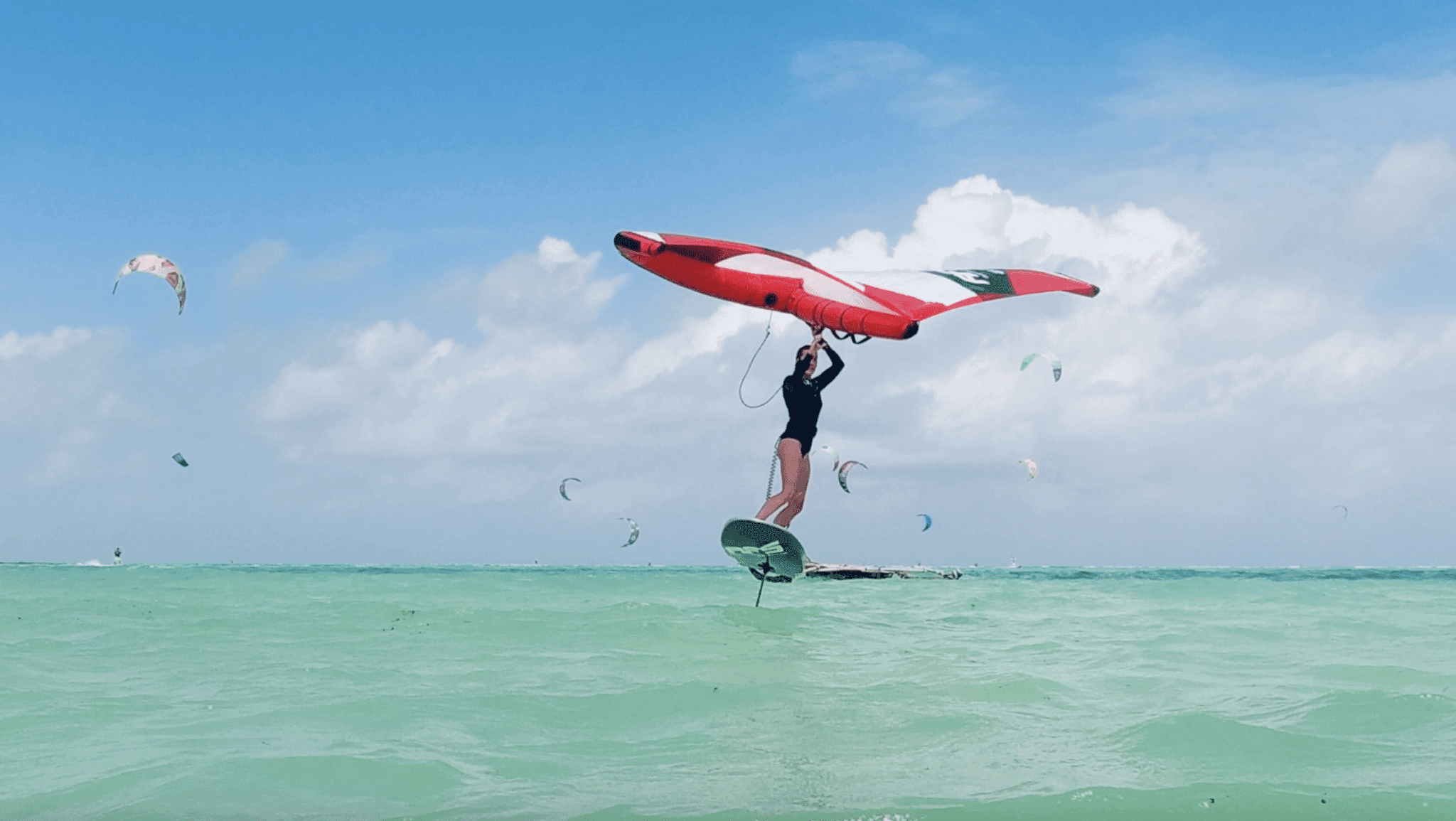
A wing foil jibe (also spelled “gybe,” and you will see “wingfoil” written as one word) is a downwind turn that takes you onto the other tack without stopping or dropping off the foil. You turn away from the wind, flip the wing to the other side and change your feet. There are two ways to do it: switch your feet after the turn (the classic jibe) or before it (the switch-to-jibe). “Switch” means your feet are reversed: your usual front foot ends up at the back.
Quick take
- Classic jibe: speed, downwind carve, depower the wing, change hands, change feet on the way out of the turn.
- Switch-to-jibe: change feet first, while you are still on your tack, then carve and flip the wing.
- Either way: keep enough speed to stay on foil, take the power out of the wing during the turn, and look where you are going.

What is a jibe in wing foiling?
A jibe is a change of direction that goes through downwind. A tack does the opposite: it goes through the wind, with your nose pointing upwind.
Why learn to jibe?
- You change direction without stopping or falling in the water.
- You can link run after run without going back to a water start.
A jibe costs you a little ground downwind. Leave yourself room and work your way upwind between turns. Before you start, you should be able to ride a steady line on foil and handle your wing.

Before you start: conditions and safety
- Flat water: less chop, fewer falls in the turn.
- Steady wind: for beginners, we recommend about 15 to 25 knots. Below that, getting up on foil is hard. Above it, things get dangerous for a beginner (which wing for which wind speed).
- No offshore wind: it can push you away from shore very quickly. Pick a wind that blows along the beach and practice close to shore (best wind direction for wing foiling).
- Helmet and impact vest: you will fall a lot. They protect you from hitting the board or the foil. Check your leashes too (wing foil hazards and how to avoid accidents).
- Space around you: look behind you and downwind before you turn, and follow the right-of-way rules.
How to do a classic jibe (feet changed after the turn)
This is the most common method.
- Build speed. Ride on a beam reach, stable on your board. Speed gives you balance for the whole move.
- Start the carve. Turn the board downwind, smoothly, knees bent.
- Depower the wing. Bring it forward and lift it up, leading edge into the wind, almost flat. It moves less and barely pulls.
- Change hands. Only once the wing stops pulling: your back hand grabs the front handle, then your front hand moves to the back handle. The wing is now on the side of your new tack.
- Change feet. Stay low, look ahead, centered on the board. Slide your back foot a few inches toward your front foot, then swap them with small steps.
- Power up again. Stand up and sheet in the wing to accelerate. If you lost speed, a few pumps help you stay on foil.
For your first jibes, you can skip step 5: ride away in switch and change feet once you are back up to speed.
How to do a switch-to-jibe (feet changed before the turn)
- Ease off a little power if you are learning: sheet out the wing (loosen your back hand) without dropping off the foil.
- Go switch without big steps: slide your back foot toward your front foot, then swap them.
- Start the carve downwind, feet reversed.
- Depower the wing above your head, then change hands as in the classic jibe.
- Power up again by easing the wing in smoothly. Do not sheet in all at once: it could yank you off the board.
Going switch while riding a straight line is often where people fall. Once you have it, the rest follows.
Which method should you learn first?
Start with the classic jibe, the most common method, and ride away in switch after the turn. That way you work on the carve and the wing flip without handling the foot change at the same time. Add the foot change once you make the turn every time.
Common wing foil jibe mistakes
| What happens | Likely cause | The fix |
|---|---|---|
| You touch down in the middle of the turn | Not enough speed going in | Accelerate before you turn and keep a steady arc. |
| The wing pulls you or throws you off balance | It still has power during the turn | Lift it almost flat before you change hands. |
| You lose balance changing feet | Switching too early, too late or with big steps | Small steps, centered on the board. At first, ride away in switch. |
| The board gets unstable | Body too upright or leaning too far | Knees bent, center of gravity low. |
| You come out of the turn with no direction | Eyes on your feet or hands | Look toward your exit. |

How to practice the jibe
Break the move down and practice each part on its own.
- On land: repeat the wing flip over your head and the hand change.
- On a straight line: go switch without turning, then come back.
- In turns: link “S” turns to feel the board carve downwind.
- Then the full jibe, on flat water, close to where you launched.
A lesson at a school can save you time: see where to learn wing foiling. To see the footwork in motion, watch Gwen Le Tutour’s video “How to switch feet | Wing Foiling” (watch on YouTube).
What gear helps you learn to jibe?
Stable, forgiving gear lets you focus on the moves. The setup we recommend for learning:
- Foil: the Evo foil full set, with an 85 cm (33.5 in) HM carbon mast. Evo is the range we recommend for beginners and freeride. Front wing area: 1,250 cm² under 60 kg (132 lb), 1,450 cm² from 60 to 75 kg (132 to 165 lb), 1,650 cm² above 75 kg.
- Wing: the D-Lite, from 3 to 6 m². For 15 to 20-22 knots, we recommend 4 m² under 75 kg (165 lb), 5 m² from 75 to 90 kg (165 to 198 lb), 6 m² above.
- Board: the Fly One. For beginners, we recommend the 5’8″ (90 L) under 65 kg (143 lb), the 6’0″ (105 L) from 65 to 75 kg (143 to 165 lb), the 6’2″ (115 L) from 75 to 85 kg (165 to 187 lb), the 6’4″ (125 L) above 85 kg (187 lb).
Foils made in France; wings and boards selected by AFS. 2-year warranty. To match this setup to your weight, use the foil finder or ask an AFS expert.
Wing foil jibe FAQ
How do you jibe on a wing foil?
Build speed, carve downwind, depower the wing by lifting it almost flat, change hands, then change feet, either after the turn (classic jibe) or before it (switch-to-jibe). The steps above walk you through both.
What is the difference between a jibe and a tack?
A jibe goes through downwind: you turn away from the wind. A tack goes through the wind. Both put you on the other tack.
Do you switch feet when you jibe?
Yes, at some point. In a classic jibe, after the turn, or later once you are back up to speed. In a switch-to-jibe, before the turn.
Why do I fall during my jibe?
Most often: not enough speed going in, a wing that still pulls in the turn, or a foot change that is too abrupt. The mistakes table gives the fix for each one.
What wind is best to practice jibes?
For beginners, we recommend about 15 to 25 knots of steady wind. Pick flat water too, and avoid offshore wind.
What size foil do I need to learn to jibe?
You pick the size for your weight and level, not for the move. Read what size foil to choose for wing foiling.
Keep progressing
The jibe takes repetition. Keep your speed, depower the wing, look at your exit, and break the move down until it comes together. Next, read our guides to the water start and jumping on a wing foil, and browse all our wing foil gear.