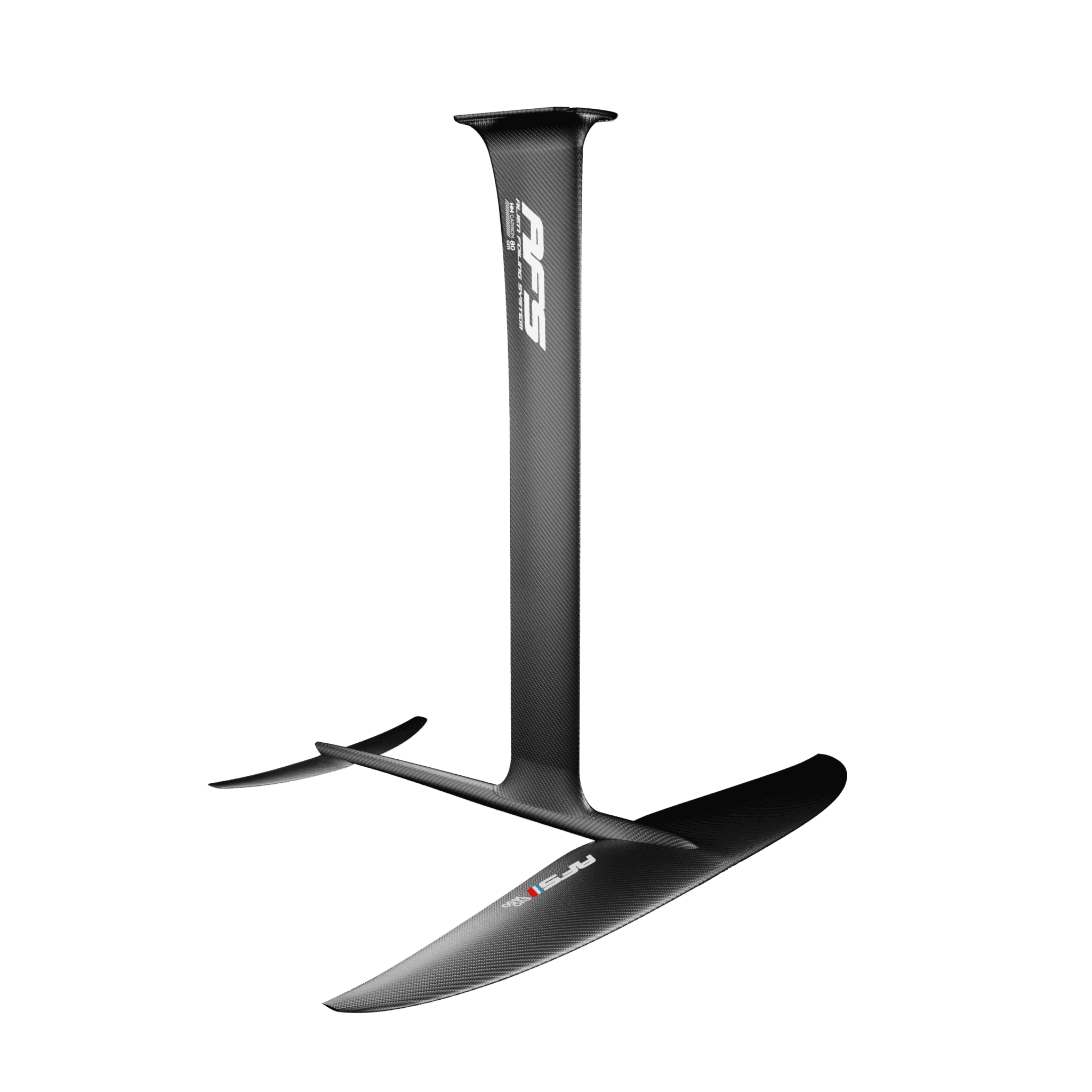
A foil, or hydrofoil, is the assembly that mounts under your board. Above a certain speed, it creates lift and raises the board out of the water. Foiling means riding that way, above the surface. A foil has four parts: a front wing, a stabilizer, a fuselage and a mast. We mean the foil you ride on water, not kitchen foil. To see our foils part by part, go to All foils.
How does a foil work?
A foil is a wing that works underwater, the way an airplane wing works in air. At low speed, your board floats. Once you pick up speed, the foil lifts the board: you fly, quietly and with almost no drag. Only the mast and the wings stay in the water.
That speed comes from whatever drives you: a wing, a kite, a wave, a boat, or your own legs when you pump.
Two rules of thumb are enough to get it:
- Front wing size follows your weight and your level. The heavier you are, the bigger the wing. At the same weight, a beginner goes one size up, an advanced rider one size down.
- Wing shape changes how it rides. Think of a glider and a fighter jet. The glider has long, thin wings: it stays in the air a long time. The fighter jet has short wings: it turns fast. A foil follows the same logic underwater. Learn more in What is aspect ratio?
What is a hydrofoil board made of? Four parts plus the board
| Part | What it does |
|---|---|
| Front wing | It carries the rider: it gets you up, then sets your speed and handling. |
| Stabilizer (stab) | It balances the foil at the back. |
| Fuselage | It connects the front wing, the stab and the mast. |
| Mast | It connects the foil to the board. |
The front wing gives the foil its character. Its area is measured in cm² (1 in² = 6.45 cm²). At AFS, the number in a wing’s name is close to its area, but not exact. To find your size, use the foil finder: enter your discipline, your weight and your level.
The mast comes down to two things. Its length depends on your discipline. Its construction depends on your weight and the span of your biggest wing. Our masts run from 65 to 95 cm (about 26 to 37 in). To choose, read How to choose the right AFS carbon mast.
Materials. Our front wings and masts are carbon; the Pure Race wing combines carbon and Kevlar. For the fuselage, you choose: carbon, titanium or aluminum. The material changes the weight: a 68 cm carbon fuselage weighs 0.56 kg (1.2 lb), an aluminum one of the same length 0.96 kg (2.1 lb). To compare, read Foil: should you choose carbon or aluminum?
You can buy each part on its own, or a foil full set with all four. Parts can be swapped, but not every part fits every other. Before adding a wing, ask our experts whether it fits your fuselage.
The board is not part of the foil, but it is part of your setup. It floats you until you fly and holds the mast. Its size depends on your discipline: a pump foil board has nothing in common with a board for learning to wing foil. You’ll find them all on All boards.
What are the types of foiling?
The principle is the same everywhere. What changes is what drives you, and so the wing, the mast and the board. Got wind: wing foil, parawing, kitefoil. Got waves: surf foil. No wind, no waves: pump foil. Got a boat: wake foil.
Wing foil
You hold an inflatable wing and ride standing on a foil board. To learn, look for 15 to 25 knots of wind on flat water. Start with What is wing foiling? and see the gear on our wing foil page.
Surf foil
You fly on the wave, with no sail and no motor. To start, read Getting started with foil surfing, then see our surf foil foils and boards.
Pump foil
You fly on your own body movement alone. No sail, no motor. You can start from a dock, a ramp, a boat or a beach. Starting from a dock is called a dock start. Read How to start pump foiling from a dock and see our pump foil gear.
Parawing
A parawing is a small, soft, light traction wing with cells and no inflatable frame. You fly it with a short bar or handles, on lines 1.3 to 1.8 m long (about 4 to 6 ft). Read How to parawing and see our parawing page.
Kitefoil
Kitefoiling is kitesurfing on a foil board. A “foil kite” is something else: a type of kite, with nothing to do with the foil under the board. See the gear on our kitefoil page.
SUP foil
SUP foiling is stand-up paddleboarding with a foil under the board. See the gear on our SUP foil page.
Downwind
You fly on open-ocean swell, wind at your back, over long distances, with a wing, a parawing or a paddle. Read How to start downwind foiling and see our downwind page.
Wake foil
Your foil is towed behind a boat. No wind needed. Read How to wake foil behind a boat and see our wake foil page.
Foil assist
An assist system fits in the mast as a pod. At AFS, the Infinity masts are built to take the Foil Drive GEN 2 and Manta Foils EVO systems. See the gear on our foil assist page.
Foils made in France
AFS has been making foils since 2009 in its factory in Brittany, France. Our foils are made in France. In 2025, we surveyed 448 riders: what comes up first is the strength and stiffness of our foils.
FAQ
What is a hydrofoil board?
It’s a board with a foil mounted under it. The board floats you at low speed. As you speed up, the foil lifts it above the water and you ride with almost no drag.
What is the difference between a foil and a hydrofoil?
None. “Foil” is short for “hydrofoil.” Both mean the wing attached under the board by a mast.
What is foiling in surfing?
It’s surfing a wave on a foil board. The foil lifts you above the water while the wave pushes you. See our surf foil page.
Can you foil without wind or waves?
Yes. In pump foiling, your own movement keeps you flying. Behind a boat, it’s wake foiling. With an assist pod in the mast, it’s foil assist.
Which foil should I start with?
It depends on your discipline, your weight and your level. Remember that a beginner goes one wing size above an advanced rider of the same weight. For an exact size, use the foil finder or ask our experts.
Where can I find a used foil?
Used foils are on our marketplace.
Now you know what a foil is, what it’s made of and what you can ride with it. To compare our front wings, masts, fuselages and stabs, go to our AFS foils page. All our products come with a 2-year warranty. For returns, see our terms of sale.