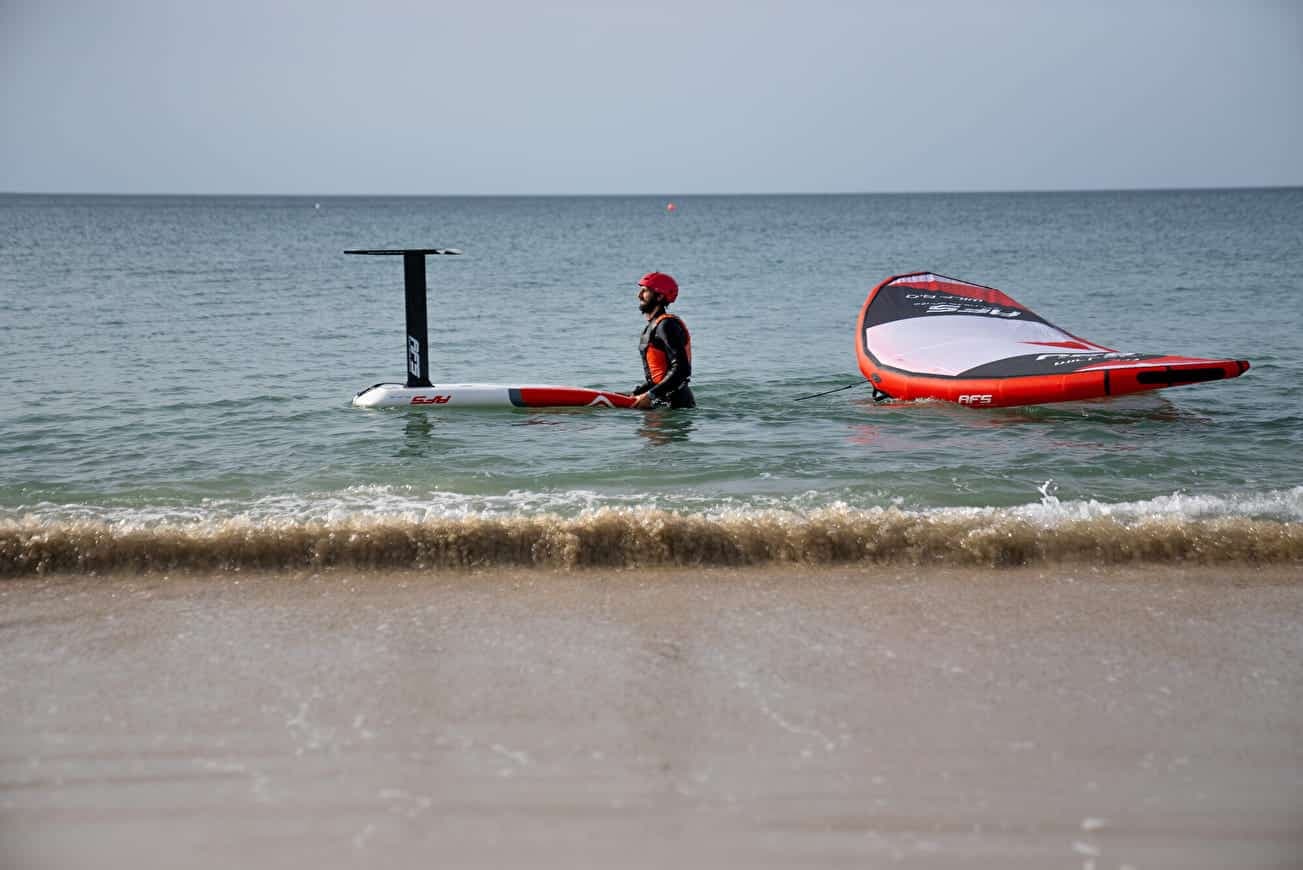
Wing foiling is a water sport where you hold an inflatable wing in your hands and ride a board fitted with a foil. The foil is a hydrofoil: a mast, a fuselage and two small carbon wings under the board. The wind pulls you through the wing. Once you go fast enough, the foil lifts the board and you fly above the water.
A wing foiler is simply someone who rides this way. Many riders shorten the name to winging. This guide covers the gear, who the sport suits, the wind you need and how to start. To see the gear itself, go to our wing foil gear page.
What is wing foiling, or winging?
Wing foiling is a mix of windsurfing, kitesurfing and surfing. You hold a wing, as you hold a sail in windsurfing. You ride a small board, as in kitesurfing. The difference is the foil: it lifts the board out of the water, and you glide above the chop.
You need three pieces of gear: a wing, a foil and a board. In this article, “wing” always means the sail you hold. The wings of the foil are called the front wing and the stabilizer.
How does wing foiling work?
The wing: your engine
The wing is an inflatable sail you pump up on the beach. You hold it by its handles or by a rigid boom, and you steer it with your arms to catch the wind. The stronger the wind, the smaller the wing. Our article how to pilot a wing foil covers the basics.
The foil: what makes you fly
The foil sits under the board. It has four parts:
- The mast: the vertical blade that links the board to the rest of the foil.
- The fuselage: the horizontal bar at the bottom of the mast.
- The front wing: the main lifting surface. Its size, in cm², is chosen by your weight.
- The stabilizer: the small rear wing that keeps the foil steady.
To understand the shape of a front wing, read what is aspect ratio. AFS foils are made in France, from A to Z, in our factory in Brittany, France.
The board: your platform
A wing foil board is short and thick. Its volume, in liters, decides how stable it feels when you stand on it before take-off. Once you fly, the board no longer touches the water.
Who is wing foiling for?
Most people who are comfortable in the water can learn it, at their own pace. You do not need to know how to surf, windsurf or kite. Your fitness, your age and your confidence all change how fast you learn.
It works many muscles. It builds strength, endurance and balance.
What gear do you need to start wing foiling?
For your first sessions, we recommend one setup: an Evo foil, a D-Lite wing and a board with plenty of volume. Pick each size by your weight. You can also browse our wing foil range or the wing foil packages.
The foil: Evo, sized by your weight
The Evo is our foil to learn and progress on. The full set comes with an 85 cm HM carbon mast, a fuselage, a front wing and a stabilizer. Choose the front wing by your weight:
| Rider weight | Evo front wing |
|---|---|
| Under 60 kg (132 lb) | 1250 cm² |
| 60 to 75 kg (132 to 165 lb) | 1450 cm² |
| Over 75 kg (165 lb) | 1650 cm² |
See our complete foils, and read what size foil to choose for wing foiling.
The wing: D-Lite, sized by your weight
The D-Lite is a light, easy wing. It comes in 3, 4, 5 and 6 m², with handles or a boom, and ships with a bag, a repair kit and a wing leash. For your main wing, in light to moderate wind:
- under 75 kg (165 lb): 4 m²;
- 75 to 90 kg (165 to 198 lb): 5 m²;
- over 90 kg (198 lb): 6 m².
When the wind picks up, switch to a smaller wing. Sizes by wind speed are in which wing for which wind speed. See all our wings.
The board: more volume than your weight
Your first board should float you well while you stand still. Aim for 30 to 40 liters more than your weight in kilos. A 70 kg (154 lb) rider starts on a board of about 100 to 110 L. See all our boards, and read which board to choose to start wing foiling.
Safety gear and accessories
- A wing leash and a board leash, so you do not lose your gear after a fall.
- A helmet, strongly recommended.
- An impact vest: it protects you from impacts and adds buoyancy while you swim next to your gear.
- A wetsuit suited to the water temperature.
- A pump with a pressure gauge.
Leashes and pumps are in our accessories. A harness is not recommended when you start. The full list is in what equipment do you need to start wing foiling.
Not sure about your sizes? Use the foil finder, or book a free call with an AFS expert.
How windy does it have to be?
To learn, look for light to moderate wind: about 15 to 25 knots (17 to 29 mph). Below that, taking off is hard. Above it, it can be dangerous for a beginner. A steady wind of around 20 knots (23 mph) is a good target.
Wind direction matters too. Offshore wind, blowing from the land to the sea, can carry you away from shore fast. Read the best wind direction for wing foiling.
Where can you wing foil?
You can ride on the ocean, a lake or even a pond, as long as it is allowed. To learn, choose a spot with:
- calm, flat water;
- at least 1.5 m (about 5 ft) of depth, so the foil stays clear of the bottom;
- few people around you.
For ideas, see wing foil spots and schools in Hawaii.
How long does it take to learn wing foiling?
From scratch, count at least 20 hours to fly and keep your balance over several meters. This varies a lot from one person to another. Most riders go through these steps:
- Handle the wing on land.
- Ride with the board flat on the water, on your knees, then standing: how to stand up in wing foil.
- Pick up speed and take off: how to do a waterstart.
- Keep a stable flight as long as you can.
Once you fly, learn to pump: how to pump in wing foil. Lessons with a qualified instructor help you progress faster and more safely. Renting or testing gear before you buy is also a good idea. Read where to learn wing foiling.
Is wing foiling safe?
Like any water sport, it carries risks. A few rules reduce them:
- take lessons before going out on your own;
- never ride alone, or always tell someone you are on the water;
- avoid offshore wind;
- wear a helmet and an impact vest;
- always use your leashes;
- stay within 15 to 25 knots while you learn.
Wing foiling FAQ
What is a wing foiler?
A wing foiler is a rider who holds an inflatable wing in their hands and rides a board fitted with a foil.
Is wing foiling hard to learn?
It takes patience. From scratch, count at least 20 hours to fly over several meters. Lessons, the right sizes and a steady wind make it easier.
What size wing should a beginner use?
For your main wing: 4 m² under 75 kg (165 lb), 5 m² from 75 to 90 kg (165 to 198 lb), 6 m² above.
How much wind do you need to wing foil?
About 15 to 25 knots (17 to 29 mph) to learn, ideally a steady 20 knots.
Do you need a harness?
Not when you start. The wing is held in your hands.
Can you learn wing foiling on your own?
You can find tips online, but lessons with a qualified instructor help you learn faster and more safely.
How much does wing foiling gear cost?
Your budget covers a wing, a foil and a board, plus leashes, a helmet, an impact vest, a wetsuit and a pump. Prices appear in your currency on each product page. A wing foil package groups the three main pieces.
Can you buy used wing foil gear?
Yes. Our marketplace sells used gear. Before you buy, read how to evaluate used wing foil equipment.
What warranty does AFS gear have?
AFS products come with a 2-year warranty. You can return a product within 14 days. Return shipping is paid by the customer.